On October 18, I received an email from Hussein Naim, an architect, researcher, and artist in Gaza. He had read some of my journalism, specifically the piece Remembering the ‘Soul of Falasteen’ Art Night , which he felt “recognizes that art can carry testimony when ordinary language is not enough.”
He shared that he’s working on a mosaic project, Coloured History of Palestine, that “uses fragments recovered from damaged and destroyed places to record daily life and memory”. A photo from the project showed people organizing rubble into the shape of Palestine.
I imagined how this might feel. How does an idea like this come to be? What is reclaimed when rubble is both medium and canvas?
Hussein wrote of the project: “I wanted to create opportunities for expression, dignity, and hope in circumstances designed to strip people of all three.”
His letter continued. He had spent years building The Memory Preservation Museum, the first museum in Gaza preserving Palestinian architectural heritage. It was destroyed in 2023. He is a research fellow with the Radical Urban Lab at the University of St. Andrews in the UK - the university's inaugural Gaza Fellow for 2025-2026 - working on a project called Forced Space (al-hayyiz al-qasri), that studies how “displacement changes the architecture and lived meaning of home.”
I had never thought of architecture in the way the project describes: a site that “mediates between survival needs and social identity… where architecture is shaped by necessity rather than design”, with special attention to how women in Gaza create spaces for domestic life during the genocide.
Hussein writes that he presented his research at universities and conferences across the world - in the UK, France, Italy, and Germany. He writes: “I do not see these opportunities as personal achievements alone. I see them as opportunities to carry Gaza's stories into spaces where they can be heard, studied, and remembered.”
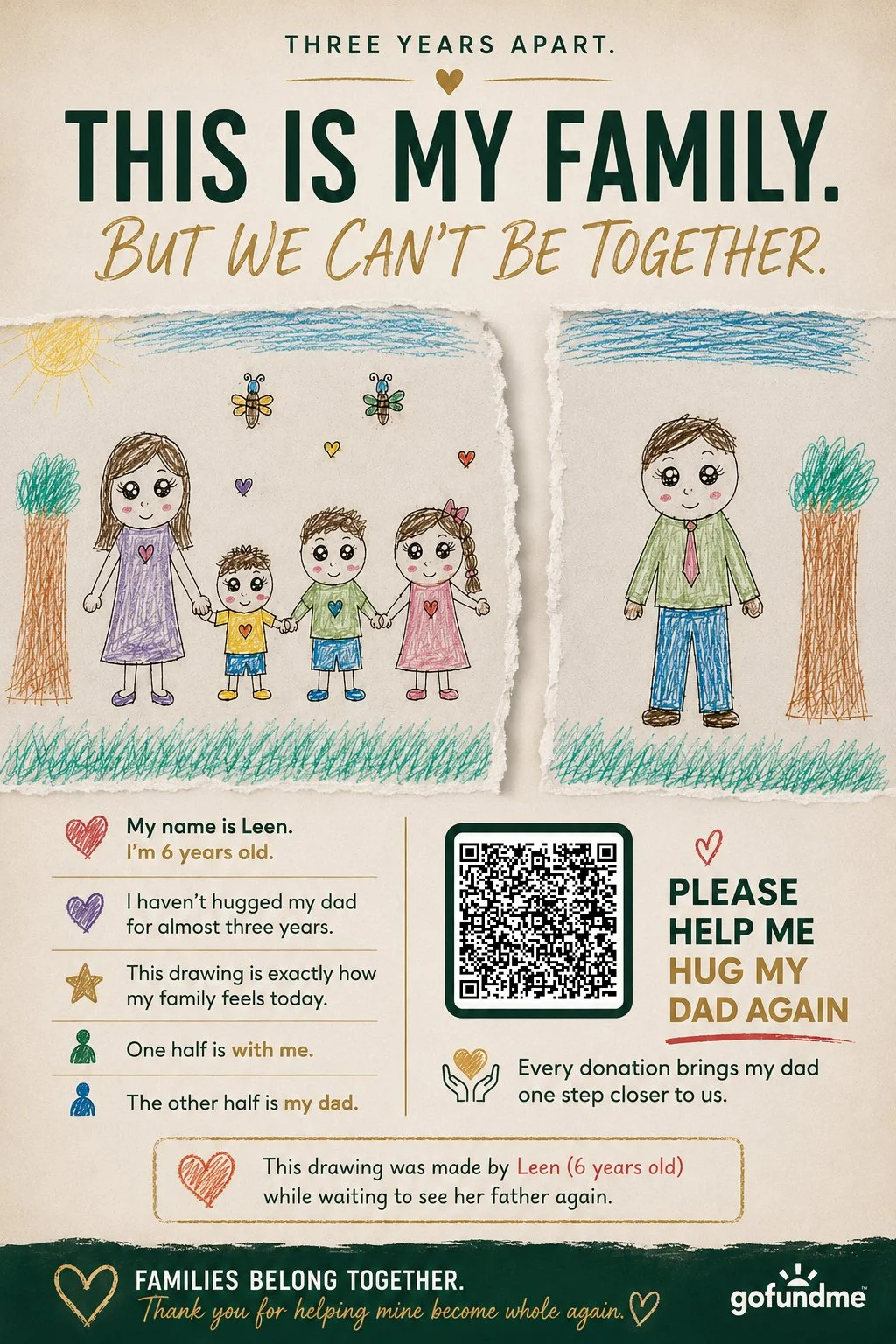
His letter included a drawing made by his six year old daughter, Leen. The drawing is torn in half. One half pictures Leen with her mother and two siblings, Qusai and Jalal, in a hand-holding chain, hearts levitating above them. The other half pictures Hussein.
“My wife and three children have been in Egypt since January 2024; I remain in Gaza, where displacement and unstable conditions continue to shape everyday life. My daughter Leen’s drawing of our separated family now represents our fundraising campaign.”
Hussein asked if I would share his family reunification appeal. There was no question that I would. I also felt that our names connected us - Hussein phonetically the same as my last name, Husain.
The campaign was created by Palestinian researcher Niveen Haliqawi, based in Glasgow. She calls Hussein her friend and colleague. A July 2026 article titled “Cooking for a cause: Palestinian pop-up” describes Niveen preparing a series of Palestinian dishes - chicken and vegetarian musakhan rolls, yogurt and chilli dips, tabbouleh, mutabaq with walnuts - at a community center to raise funds for Hussein to reunite with his family.
“This is what my soul and heart told me to do to live up to being human, to being who I truly am in my soul,” said Haliqawi. “Hussein and every Palestinian is my extended family. You never leave family behind. You never leave family stranded. You do everything in your power to support them.”
The campaign lists that funds will be used for Hussein’s departure from Gaza, housing and living expenses for his family of five in Egypt, and school fees.
Most piercingly, Hussein’s own voice lives in the campaign post: he shares all he has been through, what he thinks and feels, his efforts to teach and build community in Gaza to nurture younger generations, and his dreams of seeing his family again.
When I received Hussein’s message, I initially thought of asking if he would like to do an interview to share his story. But when I read his words, I realized they are enough: clear, blunt, impassioned, interspersed with photos.
“For nearly three years, I have been separated from my wife and our three children. When my family and I were forced apart, I believed the separation would be temporary. I never imagined that years would pass before I could hold my children again. My daughter Leen was three and a half years old when I last saw her. Today she is six and a half. My son Qusai was two and a half years old. Today he is five and a half. My youngest son, Jalal, was only five months old. Today he is three years old.”
Hussein wielded his talents as an architect, researcher, and artist during the genocide. He helped international organizations design emergency clinics, field hospitals, and shelters in Rafah and Khan Younis; worked on the design of temporary schools, emergency kindergartens, and refugee camps; helped rebuild parts of Nasser Hospital after it was bombed; trained students in architecture and art, and organised creative activities for children in displacement centres, including Coloured History of Palestine. He writes about all this with the certainty that he must help those around him.
“I believed that people needed more than shelter. They needed spaces where children could learn, play, and imagine a future beyond survival,” he writes. “I documented the transformation of Gaza's urban landscape as entire neighbourhoods disappeared. I recorded the relationship between people and place as familiar streets, homes, and landmarks were destroyed.”
I felt impressed and heartbroken.
“After nearly three years apart, I want to hold my children again. I want to sit beside my wife again. I want to be present in the lives of Leen, Qusai, and Jalal, not through a phone screen, but as their father beside them. I want to help them heal from these years of separation and displacement. I want to support their education, their safety, and their future.”
The University of St Andrews shared his campaign in a post titled “Supporting a Former RUL Fellow: Hussein Naim”. Hussein shared his portfolio with me, documenting his work and vision.
His email ends with the Palestinian flag and the following lines:
Palestine is free... Gaza is free and proud. Written from the city that knows no death, but rises from the ashes every time to teach the world how to endure... Written from the heart of "Gaza", our phoenix, pulsing with love and life. ♦
(Provided by Hussein Naim)