I watched the first part of Egypt’s match while scanning a brain
*NOTE: Why am I posting my journal entries? See my inaugural post: Beyond journalism
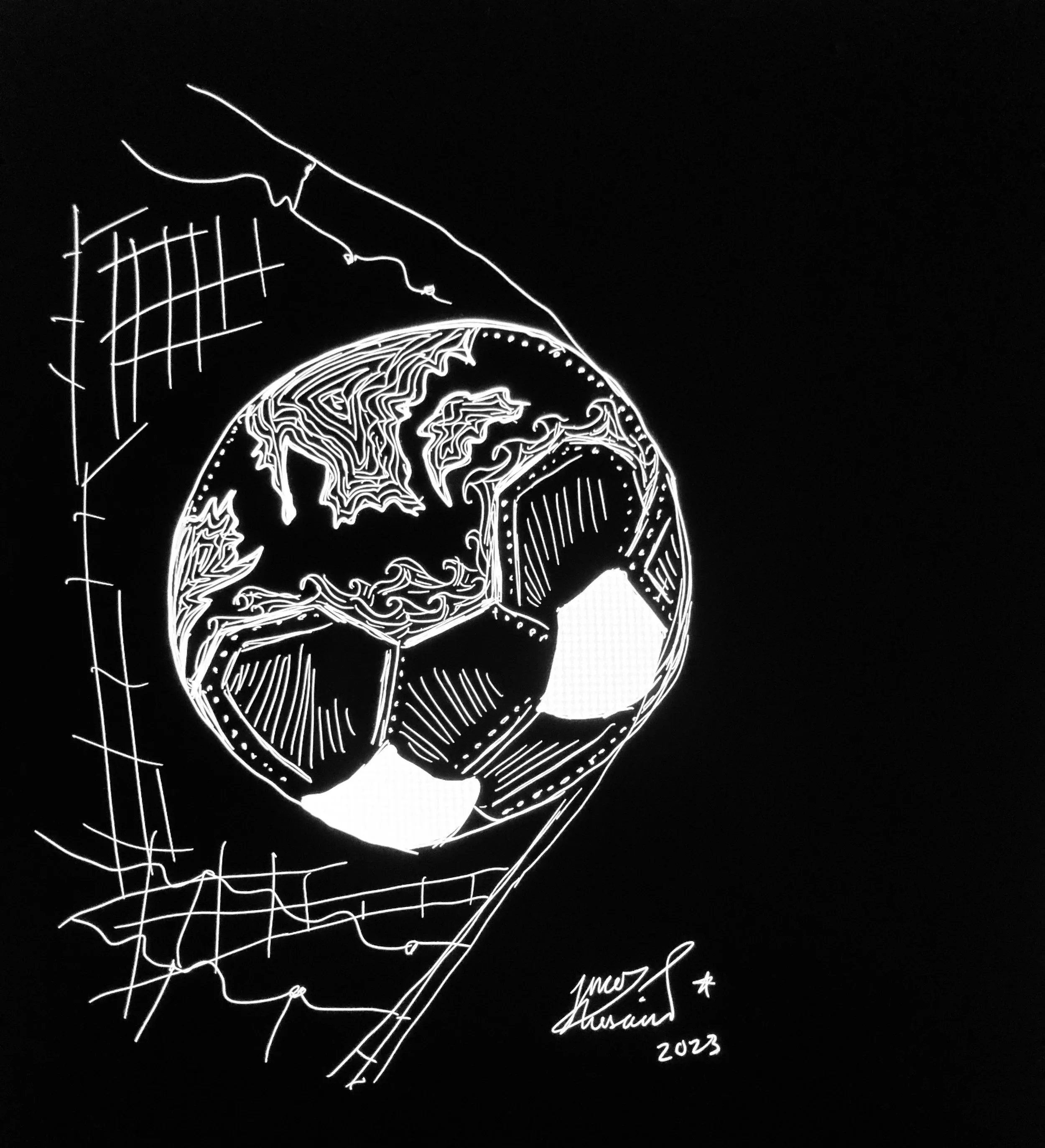
(*artwork by Incé Husain)
Right now, France plays Paraguay, and no one has scored, we’re just sixteen minutes in, and I sip my chai. My pulse hasn’t risen yet. It is difficult to say what this World Cup fever does to me, how it comes, when it begins and charges my blood. It doesn’t have to do with the football itself, or I’d be feverish with football all year round. It is the concept of countries facing each other. Sparring on a (more) even playing field, somewhere the grass is green, the rules unbendable, looking each other in the eye. The world watches, festively and with commentary - cheering, raging, sobbing. I have the sense of witnessing a free, fair world.
Some people disagree. They tell me “I don’t like the World Cup because I don’t like nationalism.” But this isn’t what I see embedded in the act of playing in a country’s flag. I see the burden, full of pride or revulsion (or some of both), of carrying the history of a people, the identity the flag has made of itself, its dent on the world. The flags of the colonizers and the colonized contrast sharply for me immediately. My instincts flare when I see these flags face each other. England vs Congo. Belgium vs Senegal. Morocco vs The Netherlands. I feel a charge like I’m closer to justice, as if there is a clear opening to deliver it.
I know this sense is false. Of course the outcome of a match will not change the ongoing outcomes of colonialism. But that is not how I feel. Not at all. I feel, pounding in my blood, this is a clean window of opportunity for justice and it will be taken by me, cheering and raging behind the screen.
When the whistle blows and the strikers surge, I get dizzy like I can taste the freedom or the dread. During penalty shootouts, I’m in agony like it’s that last revolutionary turbulent night before freedom. When Morocco missed its penalty against the Netherlands, I dug my fingernails into my neck trying to seize my rabid pulse. I texted on a group chat penalty shootouts give me heart problems. A friend who understands this state texted I am reciting the kalma. The duas rose to my lips before I even knew what I was doing, like some primordial certainty activating. It was cosmic that the Moroccan players themselves did this in synchrony, kneeling in sajdah. This intensity of shared prayer amplifies the sense of impending justice. When they won, I took a screenshot, like I needed some record of the feeling that something in the world had shifted forever, made and delivered in 120 minutes. The next day, I detailed the Moroccan victory to a stranger with enough craze in my eyes that he asked “are you Moroccan?”
This isn’t a new sentiment. Back in January 2023, when my journalism was in the pupal stage with Saint Thomas University’s The Aquinian, I wrote a sports column article called “What makes the game beautiful?”. I interviewed football fans to understand what drew them to the teams they rooted for. One said:
“If two countries are at war and they play a football game, that is not going to be non-political. [The match] helps you fight. This battle [on the football field] might be more fair than an actual war that is happening.”
I had understood him then, but I hadn’t felt its weight myself until now. The feeling is so massive, so fundamental when I’m in the midst of a match, that it crowds out anything else in me, becomes the contours of a new crazed identity that bucks like a fawn, finding its gleeful feet.
On Friday, I watched the first part of Egypt’s match against Australia while scanning a brain. Before me lay subject 9 flat on their back in the scanner. On one screen, my code; on another, glowing brain slices appearing as it ran; on the last, a big screen TV, the match, armies of red and yellow, of which Egypt in red had already scored one goal.
“What is wrong with me today?” X, next to me monitoring the brain slices, had said. “I didn’t even turn on the match!”
He found it on his laptop, projected it onto the TV hanging outside the scanner room. We tilted our heads, eyes darting, watching the scan, watching the match, as the MRI machine chirped and whirred.
“Thank you so much for putting that on,” I said. “All my teams have been on a losing streak the last three days.” I listed Congo’s loss to England, Senegal’s loss to Belgium, Bosnia’s loss to the US.
“Senegal shouldn’t have lost,” he said immediately.
“Yes. That penalty given to Belgium was completely unfair. There is no way that would have happened if the roles were reversed. The commentators kept saying it was way too harsh,’ I seethed. “And no one will even talk about how well the teams played because all the press about it will be hijacked by coverage of that penalty not being fair.”
He nodded, told me how the US had fouled a Bosnian player so badly that his ankle had rolled, and the American was given a red card suspending him from the next match.
“I think it was Bosnia’s best player too,” he said, as I stared hard at the screen. “You’re really into this.”
“I like watching the goals live and how they unfold to see if I can track exactly what happened to make the goal. And how far back in the game the premises for the goal were set. Like how far back a pass or a miss would have changed the outcome,’ I said. “Noticing that, I think, is what makes the game beautiful to watch.”
This is also how I think about history. What had to happen, and exactly when, and by whom, and enabled by who else, to change its course? How far back, before the crucial moment itself, did its beginnings form? With how much certainty can they be identified and tracked?
Australia equalized against Egypt, 1-1, while we watched. It was a header by an Australian that actually clipped an Egyptian before it struck the net, so was classified as an own goal. I thought about how we all have potential to be unintentional cogs in our own destruction by existing at the wrong place at the wrong time.
I took a photo of our three screens: code, brains, match. My keffiyeh curled over a chair spectating.
After the scan finished, I thanked X again and walked to the grad club in the heavy heat to meet Y for some journalism work. I heard Egypt’s match before I saw it. I entered and saw it projected, massive, against the wall. The grad club crowds were transfixed, seated in groups and clutching drinks. My throat tightened with the sense of impending penalty shootouts.
Y and I sat at a part of the grad club which had a good view of the match if I craned my neck. We talked about a theatre play called ‘Catarina and the Beauty of Killing Fascists’, about a girl following the 70-year family rite of passage of killing a fascist to avenge the death of a loved one under dictatorship. The fascist in the play delivered a monologue so chilling that audience members in Germany tried to attack the actor onstage.
“I really want to know what that monologue was,” Y said. “I’m so curious.”
I too was suddenly invested in this play. I kept Googling it, skimming articles, searching the faces of the actors for hints of what was to come. A flash of red catches my eye from the corner of my vision; Egypt, gathering for penalty shootouts. I ask Y if he’s watching the World Cup.
“I’m not that into it,” he says. “But I don’t want any of the European teams or North American teams to win.”
We talk briefly about nationalism and its implications for different countries, and when the shootouts begin and my heart starts racing, we abandon the journalism conversation and find seats that have a perfect view of the match.
The fever settles in me instantly, adrenaline winding. The players facing the net, bouncing between the balls of their feet until they charge. It all happens so rapidly, under two minutes. Australia misses, kicking two into the abyss. Egypt misses none. Mo Salah charges and the ball hits the net low and fast like a speeding bullet. It is so sleek, so stunning, and he just grins. I love this grin - calm, satisfied, casual, like he had never seen a universe where the penalty would not be so, that its execution was mere confirmation of what he already knew to be true. I’m on the phone while this happens, narrating it to Z, urging him to find a place to sit and watch this.
“What about Australia?” Z asked on the phone.
“They just kicked it into the abyss,” I said.
“Oh,“ he gasped. “They missed?”
“Yes. Hurry, hurry! Salah just took the pen like a bullet!”
“Yeah, he’s a really good penalty taker, okay, I’m finding a spot at the library. Bye!”
When Egypt takes their final penalty, I sense impending victory. I record it as Hossam Abdelmaguid approaches. It is agony to watch these tense seconds, the stadium and grad club holding its breath. Again, rapid duas on my lips that I cannot even remember to reel for myself.
The grad club erupts. I didn’t expect such a roar. I turn and see a group of men suddenly on their feet, rapidly hugging each other in wild escalating Arabic cheer.
“Good job,” I say, “Mabrouk!”
“THANK YOU!” says one among the mass, tears in his eyes.
On the screen, the players kneeled in sajdah.
Later, I send the grad club footage to my colleague in Cairo, and as I do this, I see on Telegram a video exactly like mine - of these crucial last five seconds of Abdelmaguid charging in red and the following tidal wave of cheer - from Gaza. People packed together in the streets, waving Egyptian flags, lighting celebratory fires, grins and glee unending, watching the communal screen hanging in the dark.
“I was so happy to see Egypt win a little while ago, but the most beautiful sight was here,” wrote Gaza journalist Tamer Nahed. “Thousands of people came out of their tents and from among their destroyed homes to watch the match. Faces lit up with smiles, cheers filled the air, and it felt as if everyone had decided to give themselves a moment of life despite everything surrounding them.”
Egypt coach Hossam Hassan walked onto the green pitch with the Palestine flag, stern and certain. He dedicated the victory to the Palestinian people: “May God grant them [the Palestinians] victory, may God have mercy on their martyrs. I’m saying to them: I’m dedicating this victory to the Egyptian people and Palestinian people, those kind and honourable people.”
See? I scream in my head, manic. See? This isn’t a game. This is a witnessing, a real victory. Here, where the rules are fucking fair.
I had run into two colleagues on my way out of campus. We commiserated and rejoiced on our recent World Cup victories. By the end, one closed her eyes, sighed, and said slowly: “And at the end of the day, it doesn’t matter who wins and loses, because it changes nothing about our lives.”
Of course she is right. She’s also Irani, and the sting of this is not lost on me. I watched the Irani team captain, Mehdi Taremi, talk about his team’s mistreatment by FIFA. Their kit teams and press teams denied visas, the football team hauled between the US and Tijuana, Mexico as their matches began and ended, granting no rest. He had said over and over: “It’s a disaster World Cup. It’s not fair. It’s not fair.”
Yes, see the green grass, here where the rules are fair(er), but only once the whistle blows, only, strictly, 90 minutes of fairness that I live in. Beyond this, everyone is unfair game. I feel crazy, delusional, when I think these days I find justice cradled between the ref’s whistles. But I do. It feeds my heart unbearably. It makes me feel and hallucinate impending freedom and beyond. ♦