Insights from animate blankets: Artist Andrew Maize’s ‘fan dancers’
Published in Antler River Media Co-op
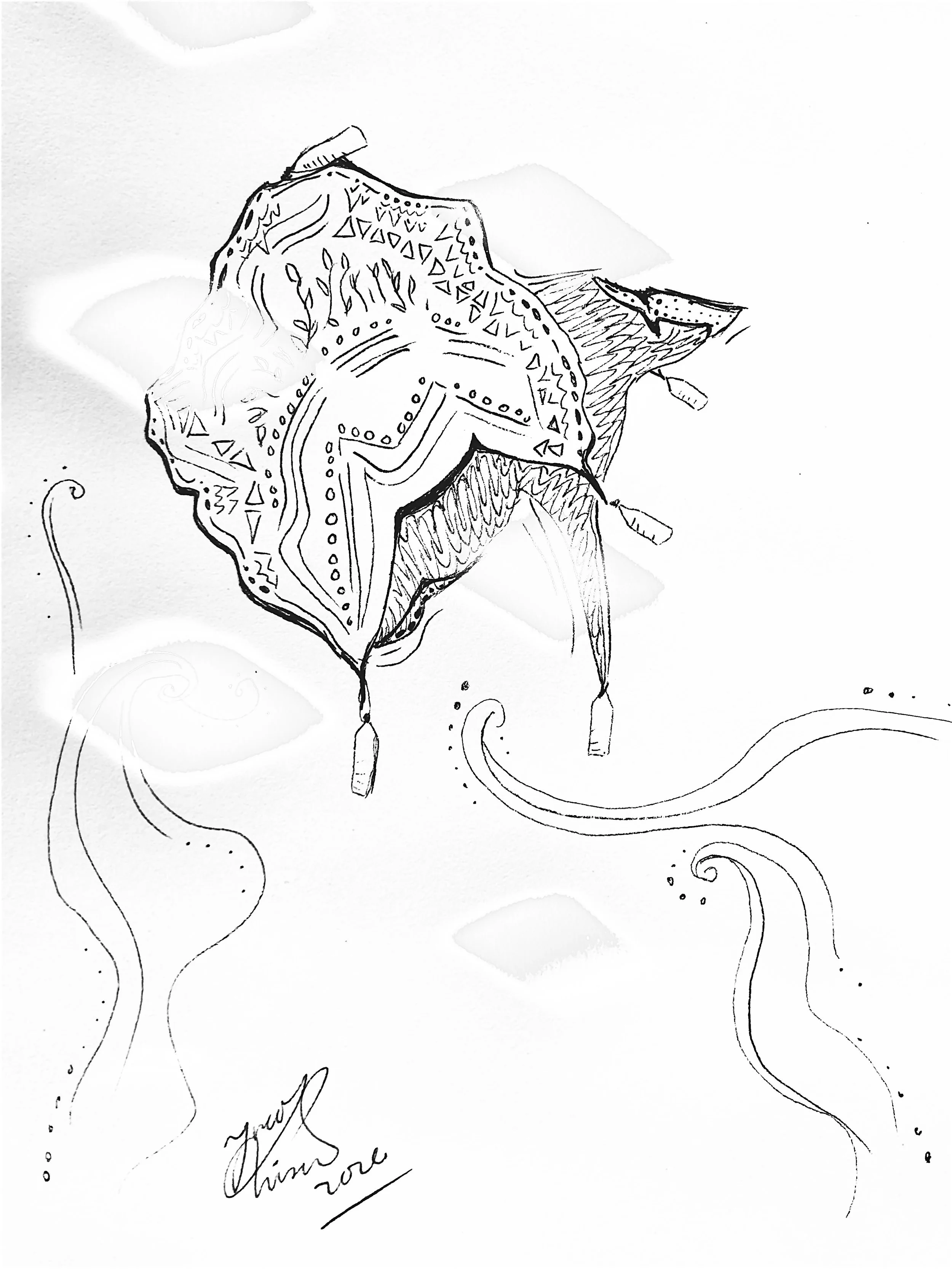
(*artwork by Incé Husain. Ink rendition of a photograph of Andrew Maize’s gold fan dancer.)
“There’s this animacy that you get from the wind. The wind fills the sails, livens a tree. I think it’s that sense of animacy we get from these blankets which otherwise are just inert material. It’s seeing that surprise on people’s faces when they first get up. It’s so exciting. There’s a sense of wonder,” says artist Andrew Maize, whose exhibit *(s)twerH is open to the public in Western University’s McIntosh Gallery until May 16.
A key feature of the windowless exhibit is a collection of gleaming silver and gold emergency blankets draped over hangers. First created in 1964 by NASA, the blankets are aluminum-coated plastic — very light, thin, and crackling like granola bar wrappers. Some are bound at the edges, tethered to charcoal and weights. Next to the blankets are three fans facing a corner. Maize’s exhibit instructs visitors to turn on the fans, choose a blanket, and launch it into the windy corner.
The result is the rise from an inert blanket to something creature-like. It perpetually soars, dives, glides, flails, bucks, or crawls in the wind. Its movements are arrhythmic, revolving around the uncertain moment-to-moment agreement of wind and weights. Its sudden slowness looks like deliberation; its sudden speeds look like urgency. Its silver or gold body crackles and fluoresces blindingly in the light, lunging or plummeting before the observer who released it.
“Some of them are more like creatures,” says Maize, comparing one of his “fan dancers” to a ridged, insectile tardigrade, and another whose assortment of weights look like paws. “But am I creating a ‘body’ or a flow that implies it but it remains abstracted? Does it need a head, a hood? I think there’s a humorous, playful, but also a political dimension. I want them to be strange and uncertain. I don’t want anything to look too much like a body per se.”
The weights attached to the fan dancers vary. Some are plastic bottles that clunk lightly when it knocks against the wall, fan outwards like claws when it's airborne. Some are homemade charcoal, giving the fan dancers scope to draw on the wall as they roam. Maize calls the weights “burdens”.
“I don’t feel like I’m playing God, but there is that thing about how I am actively creating the circumstances, the environment these things have to do their thing in. The burdens are what keeps them grounded or what they are trying to carry through their circumstances,” says Maize. He acknowledges the symbolic weight of the fan dancers’ show. “This expands out to people who control the social media algorithms, inflict CIA coups down in South America or elsewhere, where they create particular circumstances for turbulence to happen in order to topple governments… I’m thinking about all these forces at work, and how do we navigate these circumstances? I feel like the fan dancers apply to that.”
In his book, *(s)twerH, published by MacLaren Art Center in 2022 with contributions from artists Lisa Hirmer, Pascal Dufaux, Sarah Wendt, and sophia bartholomew, Maize documents the process of creating fan dancers. Always enthralled by the “whimsical nature of the wind”, Maize sought to harness it, bring it indoors to “enliven spaces that can so often feel stagnant, controlled, and dull.” Inspired by artist Paul Chan’s wind-flailing ‘breathers’, he had first tethered an emergency blanket to the center of a fan with a clip. The blanket became tornadic. Its movements were unpredictable where Chan’s breathers were deliberately controlled. He photographed the spinning, and adjusted fans and lighting to toy with the blanket’s reflectiveness. As he continued experimenting in the University of Guelph’s Zavitz Gallery, he finally attached charcoal to four corners of the blanket. He “set it free” into the wind, birthing something suddenly “unfamiliar and haunting”. He writes:
It shifted from being a loose plastic membrane blown by a fan to something strange. It had a sense of animacy. It looked like a flying squirrel. The additional weight of the tape and charcoal created a ballast, allowing the blanket to billow and capture the wind with dynamic movements like a kite while trying to negotiate an unstable and precarious environment. I felt sorry for it when it got stuck in the corner. I marvelled at its acrobatics. I was drawn in. And it also drew on the wall.
“I just try to find the happy zone that keeps most of them activated and they don’t fly out,” says Maize of the fan arrangements. “I’ve heard kids and adults alike both talk about kites and these things as ‘I could watch this all day, and it's soothing me in a way’.”
Maize’s book summarizes part of Chan’s 2019 lecture “the Bather’s Dilemma”, where art-making is compared to building a friendship defined by turning pleasure “outwards” to please others. In art, an “outwards” mindset allows materials to “take a life of their own” and decenter an artist’s initial ideas. As a result, creations exceed material things and become bonds akin to friendships. They become entities that challenge thoughts and experiences of the world in the same way that a friend might nurture.
“When you’re giving your attention to the world around you, outside of yourself, that’s a deeply human and ethical thing to do in the world — to get out of our thoughts and be able to be aware of an environment.”
During his time as artist in residence at Western University from January 19 to February 12, Maize shares that he walked along the river every day. He was attuned to its whirlpools and how his thoughts would clear in their wake. His exhibit title *(s)twerH is a root word in the theorized Proto-Indo-European language that means “rotate, swirl, twirl, move around”. It is the root of words like “disturb, turbulence, turmoil, turbine, storm, crowd.”
“I like the fact that I can't articulate the name of a thing that desires to remain unfathomable,” Maize writes in his book. “*(s)twerH is a reminder that the future is not predetermined. Shit will hit the fan, how we respond is what matters. Perceiving the world in this way offers a sense of humility, wonder, and ease. We can still cheat fate. Together, we can adapt, take care of each other, and respond to the next crisis.”
Other scenes in the exhibition include sprawling charcoal drawings, collages of photographed smoke bombs trailing through winter skies, a keffiyeh draped among a network of interlocked hangers, a copy of Palestinian writer Saeed Teebi’s memoir You Will Not Kill Our Imagination suspended in midair by a cable tethered to its spine, and a chalkboard filled with haphazard math equations, diagrams, and small notes like “Decolonize your heart”.
“I try not to have a lot of intention and just respond.” ♦
This article appeared in The Antler River Media Co-op on May 10th, 2026: