Published in Antler River Media Co-op
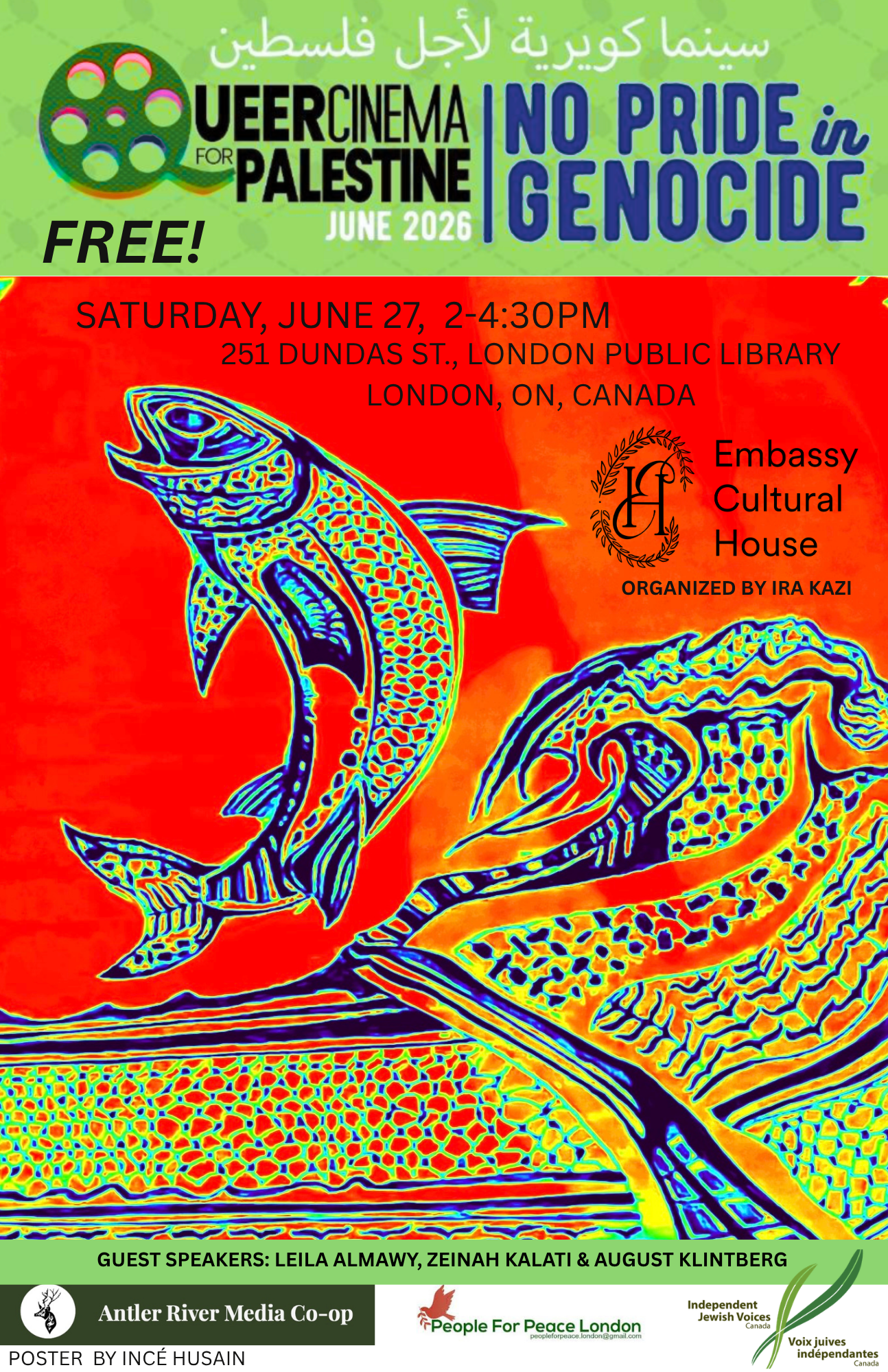
(Event poster by Incé Husain, commissioned by Embassy Cultural House)
“Queer Cinema for Palestine is about exposing and fighting Israel’s pinkwashing agenda, which uses all queer and trans identities to create a pink smokescreen attempting to hide Israel’s violent oppression of Palestinians. When an Israeli soldier committing genocide in Gaza poses for a photoshoot among the devastation while holding a pride flag with the words ‘in the name of love’, this is a textbook example of pinkwashing,” says activist Ghadir Shafie in her recorded introduction to Queer Cinema for Palestine’s 2025 program. “Queer Cinema for Palestine is about creating an ethical space for the hundreds of filmmakers who have withdrawn or refused to submit their work to the Israeli government-sponsored TLVFest LGBT film festival. Queer Cinema for Palestine is about effective solidarity with all Palestinians. We hope that these screenings will leave you with a sense of our collective power and that you will join queer and trans groups around the world that are refusing Israel’s pinkwashing and standing up for all Palestinians with the understanding that none of us are free until we are all free. I believe in your courage. I believe in our collective efforts, and I believe that together we will see a free Palestine.”
The festival’s 2025 program comprised eight short films: Abgad Hawaz by Robin Riad, Out of Gaza by Seza Tiyara Selen and Jannis Osterburg, Blood Like Water by Dima Hamdan, a tangled web drowning in honey by Tara Hakim and Hanna Hull, Aliens in Beirut by Raghed Charabaty, Palcorecore by Dana Dawud, I never promised you a Jasmine Garden by Teyama Alkamli, and Don’t take my joy away by Omar Gabriel.
The films screened across 34 countries in a record-breaking 110+ locations including London, where it was hosted by artist collective Embassy Cultural House in partnership with People for Peace London, Independent Jewish Voices London, and Antler River Media Co-op. Held annually in June to mark Global Pride Month, Queer Cinema for Palestine’s 2026 program will be returning to London on June 27 at 2pm at the London Public Library. The screenings are organized by artist Ira Kazi for Embassy Cultural House and partners, and will include remarks by guest speakers - filmmaker Leila Almawy, film programmer Zeinah Kalati, and artist August Klintberg.
“I’m really excited to be sharing these extraordinary eight films,” said director John Greyson last June, introducing the London screening. “They’re full of anger, and they're full of hope, and they're full of incredible personal passion, and they're full of joy.”
The night of the screenings, London’s Central Public Library was taut with palpable emotion. The films lured the audience into a natural intimacy: they cried, laughed, and applauded together, half immersed and half dazed, hearts still entangled in the previous film as the next would begin with new intensity. People sat close to each other in the dark; a table at the end of the room held snacks and pitchers of juice where some briefly met.
All the 2025 films revolve around love and how to bear it. Some are experimental and abstract, ruminating on relationships with the self. Some trace the tenderness and horror of being in love, from Palestine to Lebanon to the diaspora. Some blaze with love for life and insistence on freedom as the occupation bombards. The screenings closed with recorded interviews with the directors, who shared what inspired their films and what art might do to resist the ongoing genocide.
***
Abgad Hawaz, the opening film of the series, was under two minutes. It simply presented the Arabic alphabet in sequence.
Each Arabic letter entered dancing, in trembling reds or blues against white like a watercolour painting being blown. A black print filled with repeats of the letter flashed over it like an inkspill. These disruptions came with a loud, buzzing static that arose from the projector reading the letters; Egyptian-Canadian director Robin Riad had hand-drawn each letter and printed them with a laser jet printer onto 16mm film.
“The film was meant to look like a notebook, with all the different colours. It’s handwritten, it’s supposed to look printed, it's like an exercise,” said Riad, who created the film in November 2023. “There was a lot of anti-Arab hate online and a lot of racism online against Arabs, especially because of what was happening with the genocide in Gaza, and I wanted to celebrate the Arabic alphabet and show that there can be playfulness in it. We can celebrate the language without it being associated with the wars going on or the racism that is happening or the xenophobia.”
The title, Abgad Hawaz, is named after a song of the same name sung by Egyptian actress Leila Mourad from the 1949 Egyptian musical Ghazal el-Banat. Riad used to sing it with her grandparents. She chose it as the title of her film to honour her grandfather, who fought in the 1967 war, during which Israel seized Egypt’s Sinai Peninsula, Syria’s Golan Heights, and Palestine’s Gaza Strip, the West Bank, and East Jerusalem.
After moving to Canada, Riad’s mother had instructed the family not to speak Arabic, worrying that the children would have trouble at school. Riad began to lose the language. Two years ago, she sought to keep it. Her film — which she calls a “celebration of the Arabic alphabet” — is how she learned to say the alphabet in sequence.
“It’s upsetting that the genocide is still ongoing, but I wanted people to see the alphabet in a different context, in a much more playful way,” said Riad of showing the film as part of Queer Cinema for Palestine. “It is bittersweet. I don't know how to feel.”
***
Tara Hakim and Hanna Hull’s a tangled web drowning in honey also wielded the abstract. It contemplated personal struggles with the body through a lyrical voiceover that was traced by surreal, ephemeral scenes. Tweezers plucking at the petals of a bleached rose. Hakim tearing at her hair in grainy black and white footage, a crown of flowers erected on her head like a tower. Flowers falling out of her mouth, onto her face, around her neck, splashing onto her head like rain. Honey dripping over a sparkling shoulder. The film was gleaming, faded, psychedelic, tense, slow, burdened.
Thoughts like bees, insists the calm English voiceover. Am I the queen? The swarm is coming. What if I said yes to loving myself? What if I said no?... The body rejects my attempts to know it, this mass quietly tending to my survival while I try to make everything lucid... Long before I was conscious, my mind swam freely in my body, knowing when to ebb and when to flow. Then years of self-talk began to bury itself in the bone, setting my posture hunched, crooked, protecting, limping.
a tangled web drowning in honey was inspired by the prompt “If you were to write a letter to your struggling self, what would you write?”
“I didn’t know where to start,” said Palestinian-Jordanian director Tara Hakim. “I started reaching out to people and started having conversations about the language we use to talk to ourselves, and sadly the pattern was that people are way more negative with themselves than they are with other people in their lives, and that evolved into a workshop that I ran in Jordan about self-love.”
As Hakim collected letters from the public addressed to their struggling selves and tried to “perform what they were”, the 9-minute film began to take shape. Hakim also sent letters to herself for over a year. During the pandemic, she met singer-songwriter Hanna Hull, began to send them her writings, and had weekly meetings for months to talk through ideas. Finally, Hull came up with a script and Hakim responded to the words with the visuals that became the film.
“The film is not directly related to anything happening in the world,” said Hakim. “Sometimes I want to say ‘I don't want to show this film right now, it doesn't make any sense, I don't want to show any work right now’, but then I know the importance of art. I know that creating spaces and programs where people can come together and watch things, but also just maybe talk about things — I think it’s what happens in those spaces, and what may happen after, that I will hold onto for why we’re doing this…We’ve got to keep fighting somehow, and a program like this that will go around the world, hopefully, and that would raise awareness — hopefully it will spark some discussion.”
Hakim also starred in Teyami Alkamli’s Arabic film I never promised you a Jasmine Garden. The film tracks Tara, a queer Palestinian woman in unrequited love with her best friend Sarab, as she persists through mundane errands while on a phone call with Sarab that becomes inadvertently cruel. The film lushly paints Tara in the midst of her errands. She folds moist meat yellowed by spices, curly raven hair falling over her shoulder to the white wintry light. Half-excavated pomegranates lie on her counter among lemon peels. Dishes overflow in her sink. She answers Sarab’s call with a deep breath, curls up on her couch, listens while poking at an ashy incense tray by her window, pale blue eyes tense. She ventures into the streets, loading groceries while her heart breaks. Her mind dissociates in the falling snow; her scarf, her hair, her hat thicken with it as her vision blurs and her voice becomes raspy with devastation. Her heart shrivels the more Sarab’s sings. What to do but return home and blend into the flow of more errands, contribute to the bustling joy around her that she is nowhere close to feeling?
“It was really interesting for me to explore this idea between what we hear and what we see, and the composure that Tara’s character was trying to keep while really just falling apart in front of a camera,” said Syrian-Canadian director Teyami Alkamli, who shared that the film was inspired by autobiographical events. “It’s a day in the life, it’s a heartbreak love story, it’s just another way to represent Palestinian Arab queer people that I think can really help to break the general stereotypes that have been peddled by Zionists about queers and Arab Palestinian queer people in general… There are queer Palestinian people in existence just living their lives.”
***
Raghed Charabaty’s Arabic film Aliens in Beirut is about requited love found and nursed beneath Lebanon’s red sun. Two young men meet by the turquoise sea, waves reflecting the greens and yellows of flanking mountains. One of them, played by Charabaty, has returned to Lebanon after time in Canada; his lyrical voiceover, that spans the whole film, states with calm and wit: Year after year my mind returns without my body. My hatred for this land sweetens in exile, like fermenting wine…Oh alien in this city of heat and heartache, Beirut at your feet… I yearned to be drunk and burning in the heat of a world at war, brimming with the promise of hope.
As the red sun dips into the sea, as the couple plunges into massive frothing waves, as they curl on a balcony at night overlooking the city alive to the crowded hum of cars and lush trees, as they dance on rooftops and pad each other’s faces with makeup, their love deepens, and the familial friction it may cause is acknowledged but not emphasized.
Beirut is not terror and war, the voiceover says of the land of their love story. Beirut is the silence between the clouds where God has found refuge.
The beauty of rising to cigarette smoke and loving amber gazes builds until the 2020 Beirut Port explosion. Insistence prevails: Fear not death but love, my love, for love is abundant where blood has spilled.
Charabaty said the film is about alienation and refusing to be victims.
“A lot of Lebanese youth have emigrated, and when we come back we sometimes feel like aliens returning home and it takes a moment to find ourselves again, but when we do it’s so beautiful. Being an alien can be so freeing — the shapes and colors an alien gets to be,” said Charabaty, who left Lebanon when he was seventeen and moved back in 2019. “The film is also about refusing to be victims. We may be martyrs or survivors but I don’t think we’re ever going to be victims, because as the saying goes, you can kill a body but you cannot kill an idea, especially when there is love.”
Charabaty shared that he was marked personally by the Beirut Port explosion.
“I was living very close and I lost my house, my car, and I was bleeding on the streets. A lot of the arts community lives in the neighborhood that was really affected by the explosion and so it really scarred me, but it also made me so aware of the fragility of life and the beauty of being alive.”
Two years later, Charabaty went to Lebanon with a friend who is a wildlife photographer; he asked him to shoot Aliens in Beirut in a way that observed his life through that lens. Charabaty hired local artists and filmmakers, and improvised many scenes to recreate his memories up to the explosion and those of different people involved in the project.
“Even until today, much after the explosion, we continue to suffer through the attacks on our land, especially in Palestine but also in the south of Lebanon,” said Charabaty. “I believe that love in times of war is a victory.”
***
In the Arabic film Blood Like Water, the love between two young men that fuel the film is barely present. Instead, its implications as a site of exploitation seize every second. It depicts how Israelis blackmail closeted gay Palestinians into providing intelligence. Personal life is stolen and turned into a cog of occupation: they face betraying their people or becoming ostracized by them.
The first ten seconds of the film show Shadi’s face — tense, dazed, ruminating, eyes lowered, walking in the darkness. He enters his house to joyful banter: his parents enthusiastically play a board game, laughing, teasing each other, urging Shadi to join. He retreats rapidly to his room, pained. His parents follow, the exuberance in the house vanishing. Shadi divulges: “The Israelis want info on Raed. They know he’s in town to see his mother. They want to know his exact location.” His father walks to him, tenderly takes Shadi’s head in his hands, and insists as his son trembles: “Why did they come to you? Tell me exactly what’s going on so I know how to handle it.” But the revelation threatens to rupture the family completely. Shouts, sobs, breaking glass, the suffocation of a still kitchen. The film, documentary-like, has no soundtrack.
“The Israelis have always been trying to exploit people with vulnerabilities, not just the gay community, but other people with dark secrets. I thought a lot about this,” said Palestinian director Dima Hamdan. “I was interested in the conflict that happens in the household, what would parents do if they knew this happened to their son, and what are their choices. As somebody who is an ally of the queer community in general and also as a Palestinian who comes from a relatively conservative household, I don't necessarily believe that we should clash with patriarchy, sometimes we need to negotiate with patriarchy, and I wanted [them] to watch this film and know that they are seen and they are heard. It is very difficult for a father and a mother in a situation like this to risk their son being out and all the repercussions that come with that. And my question is: if the price is giving up on your core values and beliefs, and working with the occupation that is humiliating you for decades, then you have a very, very difficult choice to make. The film was made by Palestinian artists and I hope I can share it more widely in Palestine.”
Hamdan shares that the film had been shown at fifty festivals, including in Palestine, won eight awards to date, and garnered international media attention. But she wonders if the film, released in July 2023, would have been this noteworthy had the genocide in Gaza not followed three months later.
“I did not expect it to be that successful. Whether I like it or not, I will forever have to wonder if the film would have been successful if it weren't for the genocide. This is a very painful reality that I have to accept. I hope that I am doing a role, no matter how small, in keeping Palestine on centre stage even though this pales compared to the televised genocide that we’re seeing.”
***
Seza Tiyara Selen and Jannis Osterburg’s German film Out of Gaza recreates Gaza in LEGO stop-motion animation.
There are LEGO orange trees, LEGO cats, LEGO keys, LEGO Palestinians clad in keffiyehs made of yarn strands, LEGO tanks and apartheid wall filled with resistance art. It features strong-willed Aafera who has built a device to escape Gaza, elderly keffiyeh-clad Fayez, armless and wheelchair-ridden Dhakaa, and Tim the Crocodile who crows “the sewers on the other side of the walls is also my sewer.”
Aafera, Dhakaa, and Tim course through the LEGO streets on Aafera’s machine in an attempted escape from the apartheid wall, grinning as they become airborne, blasting joyful music. There is a sense of glee and impending triumph. Tanks fire at them in explosions made of cotton; Tim downs fighter jets by launching a keffiyeh at them. How is it that LEGO faces can come to exude so much character? Aafera, with frizzed hair and red lips, frowns in grief and anger. Dark-skinned Dhakaa is wide-eyed in shock and sadness. Grey-haired Fayez is fatigued and resolute. Israeli soldiers, meanwhile, are not created as LEGO people at all: they have flat forgettable faces made of bricks, cross-eyed with glitching mouths. The film closes with real scenes of devastated Rafah and genocidal rhetoric from German and Israeli politicians. Children’s plush toys — a teddy bear, a red heart, a sheep — lie in the ashen rubble.
“It has something you wouldn't expect, mixing the light medium with this not very light topic,” said director Seza Tiyara Selen, sharing that he was inspired by Norwegian stop-motion animation film The Tower that also tells a Palestinian story. “We had a lot of inspiration from friends and comrades who are here in Germany fighting for Palestine, where it is a hellhole of Zionism, and also, most importantly, from the people in Gaza who this film is ultimately about, and seeing their strength and going through those horrific events and not giving up and still seeing hope and finding joy…I really hope that to Palestinians it can give some sort of joy and hope and a little bit of positivity even though all the experiences are not very positive right now.”
Selen also hopes the film might reach German society, where he said even the left is “very Zionist.”
“As a person in Germany, I'm also hoping it can affect people here, because German society — because of its relations with Israel — is very much like emulating the settler-colonial mindset,” said Selen. “But I think a lot of people in Germany also see that the media is not telling the events correctly, that there are things that are not adding up, and I think it's creating cracks for them in the whole narrative, and we are also trying to cut into those cracks and develop them further.”
***
Dana Dawud’s Palecorecore features images and videos from Palestine throughout the years accompanied by an English voiceover that personifies social media.
I can't write a script with no image. But I have to try because I can't see you, narrates the clear, childlike voice. Our unique pixelated image — IMG_1536.jpg — dissolving into a million trillion particles of photosynthetic light… You are a river of mirrors. We refract off each other like arcade tennis.
The media overlaps like a collage. A woman gallops on a horse flanked by trees, her dark hair and Palestine flag streaming in the wind. Men breakdance on the roof and parcours through holes in walls and off buildings, soaring into the sunny air and acrobatically crashing into billowing sand to joyful applause. A child records a rap video as he walks through rubble; rappers by the sea say “rap gives us oxygen”. A photo of Leila Khaled grinning; a photo of Ahed Tamimi. A liberation dance through smoke and fire, keffiyeh wrapped around the head. Children throwing stones at a turning tank.
You who see me. I witness you witness me, says the voiceover. We are martyrs together. There is no genocide. There is only love. My body would be scattered in the air like angel dust. I’m a war crime in reverse.
Dawud created the film in November 2023. She says it is composed of archival and found footage from Gaza and Palestine that tries to create a narrative that counters the “violent image” associated with Palestine.
“We’re used to seeing violence everyday and we need to see different images that give joy and hope and give us the dignity of mourning our people,” said Dawud, who is from Jenin.
The film style is “coldcore”, which Dawud describes as a genre of new images on TikTok that are created by weaving fan footage into an emotional video montage. She was taking a seminar on coldcore when the genocide began.
“I could only apply these montage techniques to something that relates to what’s going on because that was everything that I was consuming at the time,” said Dawud. “The images show a version of Palestine that existed years ago and we could see that these images could exist now if the genocide is not being perpetrated against Palestinians…It’s the rule that has been sadly repeated in Palestine against our people, and also our people in Syria and Lebanon as well. We don’t forget them and I think that every time this film is screened, it is just a reminder that we're losing so much.”
***
Omar Gabriel’s Arabic film Don’t take my joy away was filmed in Palestinian refugee camp Shatila in Lebanon. It begins with two men dancing and singing — your love butchered my veins, your love shapes my life and dreams, your love is my language and peace — until their seamless joy is disrupted by a window-shattering blast. The camera suddenly begins shaking as the two run from bombs. They dance as they flee, weaving through buildings, beneath buzzing warplanes, from the silo of an ashen corridor to a rooftop beneath the sun. Their dance is spinning, convulsing, flowing from frenzied to slow. They raise hands through a torn building, collapse their hands over their faces like in prayer, find and hold each other, raise their arms to catch the sun. It ends with a Palestine flag, with laughter.
Lebanese director Omar Gabriel calls the film “a dance from darkness to light”.
“The weight of this violence, I was carrying it in my body and in my psyche and I was all the time asking myself ‘what can I do’? How can we, facing this atrocity, help ourselves, liberate ourselves from this tension? For me, the body carries all this weight, carries this trauma,” said Gabriel. “I thought that the best way to convey this expression of trying to liberate ourselves from the violence is through the body, through the movement, and this is why I decided to do a film that has no dialogue, that has just an attempt of liberating the body from everything it is carrying.”
Gabriel considers his camera his tool of resistance.
“As a filmmaker, the only tool I have to contribute is my camera,” he said. “I will continue to speak up, I will continue to bring these narratives for awareness, for sensibilization, because I think art is the way to touch people, and if people are touched, that’s a way for them to start thinking differently.”
***
The London screenings included a collective action with the audience. They chanted “QUEER CINEMA FOR PALESTINE, NO PRIDE IN GENOCIDE!” for a short video to commemorate the screening. The footage forms part of a six minute video that stitches together such celebrations from all over the world.
The 2026 program, set to screen in 300 locations worldwide across fifty-nine countries, will feature six short films: A Message by Mama Gannush (Palestine, 2026), Ceasefire بِكَفِّي قَهْـر by Teodor Vladár (Slovakia/Hungary, 2025), The 5-year Plan for Financial Independence by Dua Omari (Palestine, 2025), Until We Return by Huss AC (Egypt/ Scotland, 2025), We Will Haunt Your Archive by R.R. (United States, 2026), and Sorry by John Greyson (Canada, 2024). ♦
This article appeared in The Antler River Media Co-op on June 12th, 2026: