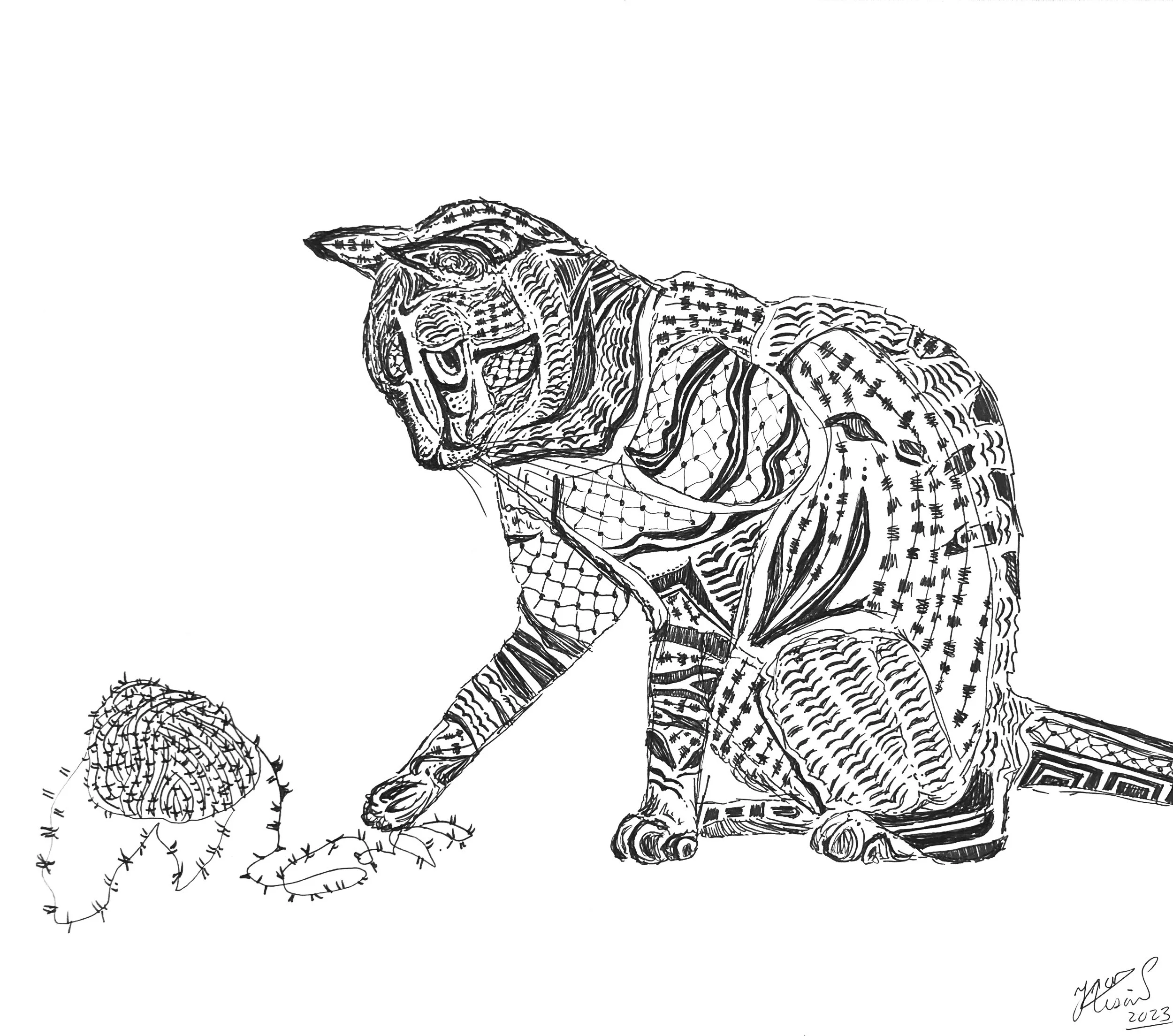
(‘Cats of Gaza’, filled with keffiyeh patterns, by Incé Husain)
My hands were trembling before the film Thirteen in Gaza began. It was not fear, but a blockage. I wanted distance from the feelings that might come when witnessing a thirteen year old girl come of age during a genocide. I anticipated becoming mute, dazed, and unable to write.
Shot and produced entirely in Gaza’s Al-Awda camp, Thirteen in Gaza is Palestinian director Hosam Abu Dan’s narrative feature debut that had its world premiere at TIFF 2026. It’s a story about a father and his teenage daughter navigating life in a refugee camp, aiming to show “humanity rather than destruction and survival rather than despair…an insider’s intimate view rather than an outsider’s sensationalistic gaze.”
Seated in the cinema on September 10, I was preparing for pain I could not begin to imagine. News notifications about Gaza from the last hour arrived on my phone:
Israeli drones drop leaflets over the Jabalia refugee camp in the northern Gaza Strip
Sisters Lana and Bana Moamen Ahmed were killed today alongside their parents when Israeli occupation forces bombed..
Scrolling through headlines, I felt relieved that the film was only 77 minutes of this unending violence.
But Thirteen in Gaza did not traumatize in the way I was bracing for.
Thirteen in Gaza immerses the audience in the innocence of a thirteen year old girl and a father’s love. It depicts emotional life that pulses with universality. It is not a graphic film about survival - as the headlines often portray - but about dignity that refuses surrender to harshness.
Firas Al-Masri and Mary Ziyara’s performances are engrossing as father and daughter. Their burdened faces seem to be universes of memory and contemplation. The poignancy of the whole film could be delivered simply by gazing into their eyes. The cinematography uses close ups to build intimacy, intensifying the stillness of their expressions. We see lingering glances contrasted with wide shots of the refugee camp, dusty and sprawling beneath the red sun.
The opening scene is a silhouette of Ziyara’s character, Raghad, through a charred window. She is on a bed, the shot focusing on her statue-like stare into space. Every feature of her face is burdened. She has her blood pressure taken; there is an explosion in the background; the shot does not stray from her face. Suddenly, the shot cuts to bloodied feet dangling from a chariot, bodies hidden beneath sheets. Someone yells, without being shown, if you’re alive, bang on the rubble. We borrow Raghad’s eyes as these visuals of death fill her nearly 20-minute silence. When the shot returns to her, we are in a lull of stillness as she walks through the dusty camp, her figure noticeably small against the tents. She settles into the tent shared with her father. The shots of her life’s routines are slow, belaboured: she brushes her chestnut hair, folds clothing, and stands in long lines for the washroom as she begins to menstruate, a naive terror more emphasized in the film than bombardment.
Thirteen in Gaza is steered by the new rituals of Raghad’s body. We learn that the most stressful part of her day is going to the bathroom: the toilet is a bowl in the dirt surrounded by makeshift walls, the line is long and agitated. There are repeated scenes of Raghad washing the rim of the bowl in the cramped space. The shots zoom into her pale face, then her feet pressing into the mud as she sits. The cinematography’s loyalty to her experience gives these scenes a sense of intimacy instead of intrusion.
I didn’t consider how difficult it would be, culturally and artistically, to film a scene this private. I saw Raghad as shy, curious, anxious, lonely, and uncertain in a way familiar to me when I was thirteen. I didn’t feel I was invading her space; I felt there was enough sameness in our feelings for me to soothe her like an older sister. Her privacy is instead denied by the buzzing of warplanes and people banging on the makeshift door. Emotionally in synchrony with her, I felt her flinch down to my toes.
Raghad tries to hide her period from her father, gathering her clothes to wash and eyeing him uncertainly. When he learns of it, he insists that she don a headscarf and a long coat. “We’re living in a tent, people packed all over us,” he tells her. “The last thing we need is people gossipping about us.” Displacement has not taken Raghad’s instincts adapting to her first period, nor has it taken her father’s insistence on their way of life. This exchange - one of many - is how the film delivers dignity.
Raghad’s relationship with her father unfolds slowly within their shared tent, anchored by the material remnants of their life. She fingers a knitted hat that still smells like her grandmother; she asks her father if they can go home; she holds a teddy bear from her mother, who was killed. The scenes are shot from inside the tent, as if we share the space with them. The screenwriting favours storytelling: characters state what they feel and think, confessional and trusting. “The last thing I remember was a red flash,” Raghad says to her father. “Then I woke up in the hospital. I thought you pulled me out of the rubble.” It is unbearably clear that all they have in the world is each other. I don’t remember Raghad’s father even being called by his name; he is referred to as Abu Raghad (“Raghad’s father”).
The father-daughter relationship is strained by Khalil, played by Ghassan Salem, a displaced man who hoards the little resources in the camp - food and survival needs - and sells and acquires them in coordination with the Israelis. He has a tent filled with spices, sugar, and cigarettes; he plays cards while smoking and listening to the radio. When someone urges him to distribute the materials across the camp, he says: “The starvation hasn’t even started yet. The crossing isn’t opening.” Khalil uses this relative abundance to coerce the father-daughter pair, fuelled by Raghad’s coming of age and her father’s insistence to protect her. The dynamic between the three builds slowly, with ambiguous interactions and a rising sense of dread. Salem’s performance is chilling. He toys with Raghad’s father, charming and controlling. The most painful parts of the film are when Raghad’s father tries to speak to his daughter as a woman while she responds like the child that she is, unknowing and naive. Her father’s deliberation about what to do is shown through shots of his face as he smokes in his tent, refusing to answer Khalil’s phone calls while Raghad sleeps. It is an excruciating situation with no path forward that can bring peace. But his climactic decision is one of the most piercing embodiments of dignity I have ever seen.
It felt like a betrayal to leave the cinema. I felt guilty crying afterwards in the washroom – more than Raghad throughout the film – and guilty tearing out tissue paper and putting packets of sugar in my coffee.
How is one to review a film like this, inarguably historic, blurring the line between feature film and documentary?
I hope that all who watch Thirteen in Gaza might see themselves in Raghad, her father, or even Khalil. I hope they don’t see “Gaza” in the title and anticipate a flood of trauma, as I initially did. While it may seem rational to anyone in touch with the news and with human rights reports to approach the film this way, it would not be accurate or kind. Thirteen in Gaza is too intimate to allow distance. It is a breathtaking look past the headlines.
“The film was shot under extremely difficult conditions, amid the war and limited resources,” said director Hosam Abu Dan. “We filmed whenever circumstances allowed, and we tried as much as possible to find locations that met the film’s requirements while ensuring the safety of the crew. We were just meters away from attacks by occupation soldiers.” ♦
“Thirteen in Gaza” won the NETPAC award at TIFF, awarded by the Network for the Promotion of Asian Pacific Cinema. It is the first fiction feature film to be shot in Gaza in 12 years.