Edward Said: Between Worlds – “We were there. You can’t do more than that.”
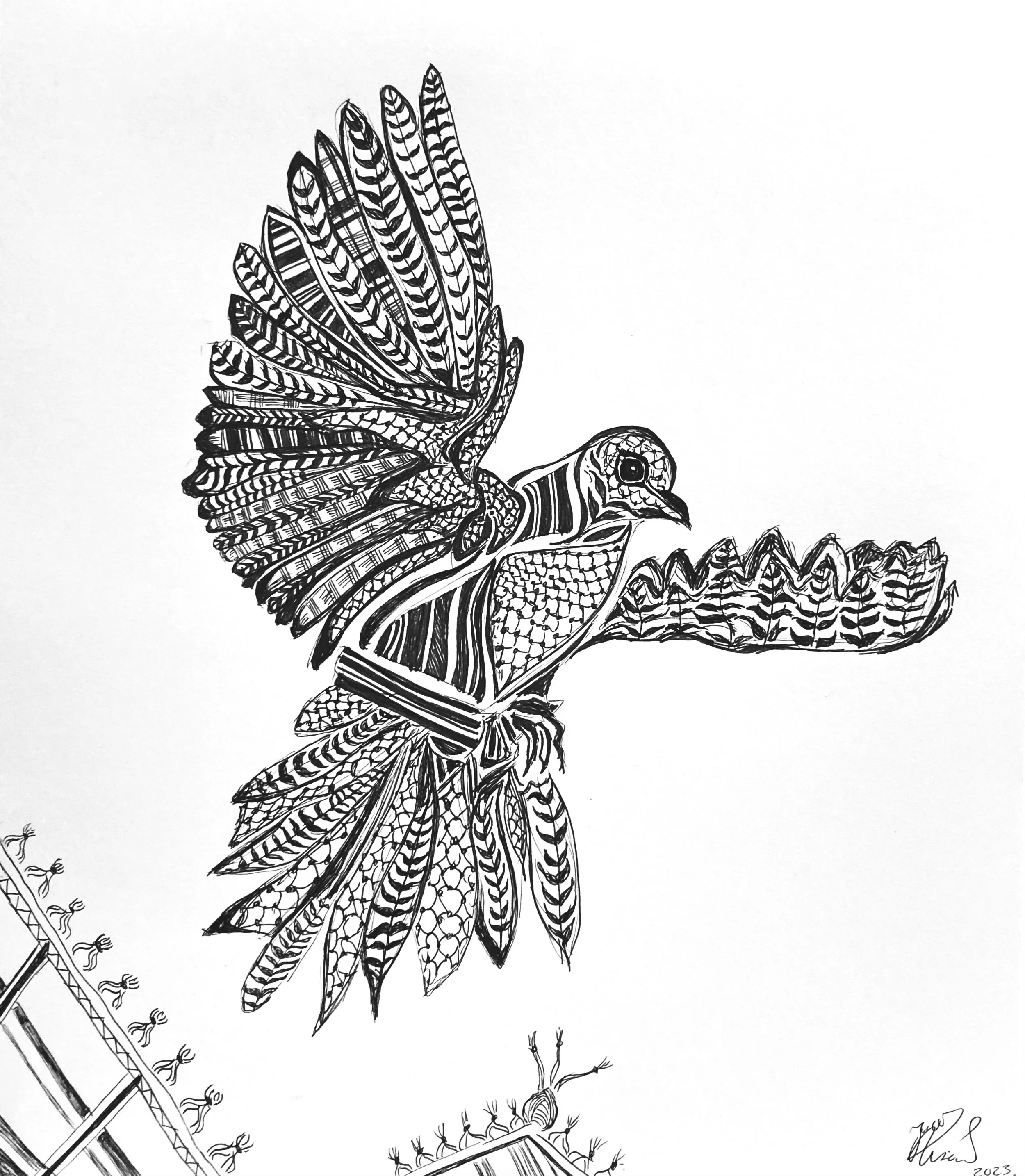
(*artwork: Liberation dove, filled with keffiyeh patterns, by Incé Husain)
Edward Said was always a familiar name at my dinner table. Since I was a child, I walked past our oak bookshelf that carried the spine of his magnum opus Orientalism, intrigued by its cover image of a thick blue snake coiled around the torso of a young boy. My father would listen to Said’s lectures at his home office. Sometimes he would invite me, peering from the doorway, to listen; sometimes I would catch stray phrases. From this early osmosis, I came to a vague yet strong sense that Said spoke about “our part of the world” - whatever that meant to a Muslim Pakistani child raised in Canada - in a truthful and crucial way.
In December 2023, jarred by the beginnings of the genocide, my father put on Said’s lecture “The Myth of the Clash of Civilizations" for the two of us to listen to. Said dismantles Samuel P. Huntington's book “The Clash of Civilizations” by describing in detail the degrading, dishonest portrayals of non-Western civilizations that form its premise. My father had made us apple cinnamon tea, like listening to Said was a cozy movie night. We’d thought of Gaza, cried, and wondered what we might do with Said’s words. He had a way of distilling what is true - and how to proceed - from a mass of rhetoric intended to abuse some and elevate others.
This pull towards Said’s voice in the current moment was also felt by Danish-American director Maiken Baird. She reached out to Said’s daughter, Najla, and, with Palestinian-American producer Sarah Mowaswes, they created the documentary Edward Said: Between Worlds. Its World Premiere was at TIFF 2026.
“Shortly after October 7, I was really missing Edward Said’s voice and his wisdom and his humanity. I had known him in the 1980s, I went to Columbia University where he taught, and my parents were friendly with him and his wife, Mariam. I had sort of heard him at home coming for dinners, and heard his stories and his way of describing the Middle Eastern situation, and it was just so interesting,” said Baird on September 13 during our interview at TIFF. “So I thought it would be great to bring him back.”
The film begins cleverly with a collage of voices in media describing Said over the years, reiterating his legacy for those who know him and introducing it rapidly for those who don’t.
“A man of many worlds - art, politics, music, letters, East and West”.
“A Palestinian born in Jerusalem, sent into exile in 1948”.
“The most influential literary and cultural critic in the world”.
And Said’s own matter-of-fact introduction:
“I would like to be identified as a professor of literature at Columbia University.”
I predicted that Between Worlds would be both a relief and an inspiration for me, chronicling Said’s writings with the anchor of Palestine. I thought it would strengthen me to hear 107 minutes of his thoughts on Palestine and on the colonialism that still plagues the media, especially as a journalist.
What it did was far greater. The documentary built a picture of how he felt.
Between Worlds shared answers to questions I realized I’d never asked about him. How did he feel as he gave interviews and lectures to the West about Palestine and colonialism? How did he feel when he wrote Orientalism, becoming the founder of postcolonial thought? How did he feel as history unfolded around him - the Nakba that exiled his family from Jerusalem to Egypt when he was twelve, the 1967 war that broke out as he began a professorship at Columbia University, the 1982 invasion of Lebanon while his mother was in Beirut, the first Intifada, and the Oslo accords? What was he like as a child, at school, and with his family?
I realized that Said was such a compass for me, his lectures unclogging the blockages in my mind piece by piece, that I missed the extent of his personal tie to them. After watching Between Worlds, I can’t listen to him in the same way again. In his interview responses and lectures, I think of the personal feelings and memories driving them.
“It took me until almost two years ago to really understand what it meant that my father lost his home at 12 years old,” said Najla Said. “I knew that fact but I never felt it emotionally, and I think this film does a wonderful job of telling his story along with the history of Palestine.”
The documentary never strays from delivering a cohesive history of Palestine through Said's eyes. The film drew from over a hundred hours of coverage - lectures, interviews, family photos and videos, some of it never before aired - to revive his life’s narration.
“We stuck to his actual story, him telling this story, because Palestinians don’t have the right to narrate, they don't get the sort of platform to narrate their own stories. And so to have someone like Edward Said - who was the most famous Palestinian-American of all time - narrate the story is fascinating,” said Baird. “He’s also able to contextualize the history as what happened to him, and then what was happening historically at the time as well. So those two combined were the things that we really selected to keep in the film, even though there were many things that were super interesting, but they didn't really fall into how we understand today through his story.”
The documentary is fast-paced, unpredictable, and non-linear, tethered by the continuity in Said’s ideas rather than chronology. Through a collage of media clippings, photos, family videos, and voiceovers - including of Ghassan Kanafani, Kamel Nasser, and Yasser Arafat - it is a panorama of testimony from Said’s surroundings and his reactions in real time. His feelings, perceptions, and convictions as he learns and grows are vivid; it is like we walk side by side with him.
“So many people only know Edward through his writing, or maybe a few documentaries that they might have seen,” said Sarah Mowaswes. “We really wanted to give people this full understanding of who he was as a person.”
Throughout the film, I could not dislodge imagery of the present. When I saw clips of Said teaching at Columbia University, I thought of the student protests and encampments there in 2024. When Said declared that “the media has done a tremendous disservice to peace by misrepresenting the realities on the ground”, I thought of the 2025 book When Genocide Wasn't News: How Canadian Media Covered Up the Destruction of Gaza by independent Canadian media outlet The Breach. Said's commentary on the media’s abuse of language, its “failure to use words for exact historical purposes”, its invocation of “terrorism” in bad faith to “strip the enemy of identity and cause”, still reverberates today. I wondered if there had been a temptation to weave such elements of the present into the documentary, bringing Said directly into the current moment.
“I think the issue with bringing back now is ‘where do we end?’” said Baird. “A year from now, it will be something else, two years from now it will be something else…I thought the problem with putting October 7 or any of the things that are happening today is, it sort of dates (the film) in a way… It just made more sense to me that we ended when he died because then we kept it very much within when he was living and showing that nothing has really changed since he was actually speaking about this in the 70s, 80s, 90s…Basically everything he was working towards is things that we see today. It's all relevant, it all explains and informs what we're seeing today.”
The film includes photos and videos of Said’s childhood in Jerusalem, clips showing Said and his sister rushing excitedly towards the camera held by their father. Said felt his childhood unfold in “two parallel streams…as two Edwards”: one embodying discipline, family, and school, and one where his freedom lay - imagination and reading.
Said recalls memories of the Nakba, the “rising sense of danger” when Zionist gangs bombed the King David Hotel in 1946, a wreckage he saw from his house. He had “no available vocabulary for the question” when all his family - from grandparents to the youngest grandchild - became refugees by April 1948.
We learn that his political awakening did not come until his mid-thirties as a young professor at Columbia University, while watching American streets fill with Israel flags during the 1967 war. He began to relearn what it meant to be Palestinian, an identity that had become buried by displacement and moving to America. He reconnected with the Arab world even more after meeting his Lebanese wife, Mariam. He describes vibrant memories of Beirut, relearning Arabic, and reading the classics of Arabic literature - like Ibn Khaldun and Ghazali - for the first time, an immersion that opened the door to writing Orientalism.
“One of my favourite things about the film is that he has this rebirth - that he didn't know everything, that he went back and taught himself,” said Mowaswes. “And that's really humbling and really - it's something that I think a lot of people can identify with, that if you don't know everything you can go back and educate yourself, you can try again, you can reinvent yourself, because he did that at such a late stage in his 30s. So experiencing that through Edward was also this personal shift that I think a lot of us, myself included, had on the film - of understanding ourselves better as we understood him.”
The film oscillates between Said’s worlds in the West and East. He meets Palestinian families in refugee camps in Lebanon, conversing with them warmly in fluent Arabic; he asks them, with curiosity and humor, “I live in America and I am Palestinian. What should I do?”. He debates Zionists and gives interviews in the US, embedding Palestine in Western consciousness with measured arguments. He called moving between the two worlds “exhilarating.”
“We were there. You can’t do more than that,” Said declared, impassioned, as black and white scenes of Palestinian life - dinner parties, weddings, marketplaces - flickered alongside his voiceover. “It’s so indecent and humiliating an exercise to have to say that we do exist. There were villages, Palestinian villages, there were Palestinian cities, there was a Palestinian society, there were Palestinian people, before 1948. Which, abruptly and dramatically, was shattered.”
After watching Between Worlds, Said has become someone I listen to not only for scholarship, but for a glimpse of how I might conduct myself when delivering my own truths in the West. He shows me that there is a way to be both measured and incisive, passionate and calm, angry and eloquent, polished and truthful.
“As his child, I thought he was always fully formed. As his daughter, I only knew him after he became ‘Edward Said’,” said Najla. “He talks in the film about how 1967 was this moment where everything shifted for him. And I think many of us had that. My generation, we first had that on September 11, but then it became even more intense after October 7. And to know that he went through the same thing where he had to have that galvanizing thing that made him lock in and really understand who he was and try to figure out what he wanted to say and what was important I think is fascinating. When someone is lionized and made a hero, you think ‘oh they were always like that’ but to see that there was a journey that's very similar to the journey that all of us go through is also really interesting.”
For me, the climax of the documentary is Said describing how he came to the idea of Orientalism – the book that argues the “divide by East and West was invented by human civilization.” The film delivers Orientalism beautifully, illustrating the global sensation it became alongside Said’s unassuming recollection of how he felt while writing it. The scenes had both a sense of intimacy and of stardom, like a friend sharing a world-changing secret just before it is unleashed.
For Najla, the film’s defining moment was when her parents met.
“For me, it's that moment where he meets my mom and starts going and learning and becoming Arab, really, in a sense. To me, this idea that my dad was not originally ‘as Arab’ as he was is fascinating,” said Najla. “I hadn't really known this until 15 years ago, that really, my mom who’s Lebanese was the person that brought him back to the Middle East. Having grown up very American myself and wanting nothing to do with the Middle East for a long time, I had no idea that my father had - he was less actively pushing away the Middle East - but we were in a similar position of being in America and like ‘okay, I guess I have to default to try to be white because I don't know what else to do with myself’.”
For Mowaswes, the documentary’s focal point was the First Intifada. Said described it as a time when “fear is forbidden…everyone feels he or she is willing to make sacrifices.”
“For me, it's the First Intifada. That was a section of the film that we worked really hard on…And ultimately we included it in the film for two reasons. Not only is it a part of a huge climax in the Palestinian story, but it's also a huge climax in Edwards's story, where suddenly he was on TV all the time, he was the Palestinian perspective, he was the Palestinian narrative that was being called upon. And for us it was a really exciting thing to include because it was finally Palestinians speaking for themselves and taking action,” said Mowaswes. “It's not included in the film, but Edward has this amazing speech that he gives at a university during the First Intifada where he says "Palestinians - all they have is the literal soil around them, and they're using that to fight back because it's all they have”… Samia Khoury is in the film and she says ‘the younger generation, they're fed up. If you couldn't fix it, then we will’. And that sort of feels like what's happening today with Palestine. The younger generation is saying ‘we don't want to live under occupation anymore, we want our self-determination, we want our own voices heard’.”
Between Worlds is a stunning film I would watch again. I recommend it to all who wish to understand the current moment, both historically and emotionally. ♦
Interviews with Maiken Baird, Najla Said, and Sarah Mowaswes conducted in person by Incé Husain and Emmanuel Akanbi.