“I want people to understand”: Writers in Gaza publish zines through volunteer-led Coastal Lines Press
Published in Antler River Media Co-op
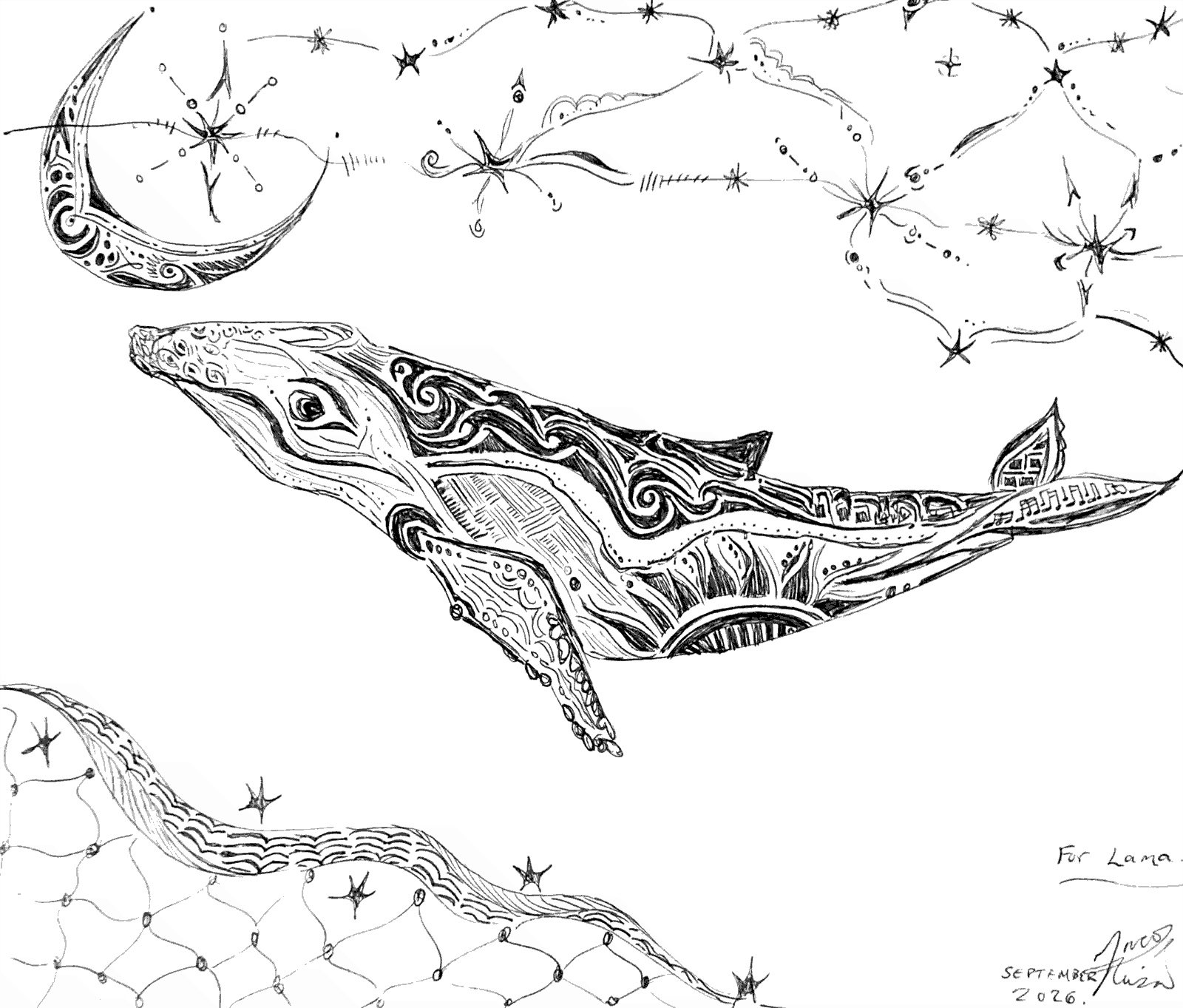
(*artwork by Incé Husain.)
Audio excerpt of meeting with writer Lama Alharazin, including Alharazin reciting her poem "Those who are still here" from her zine "Rain Was Once A Promise":
“My name is Lama Alharazin. I am 24 years old. I hold a bachelor's degree in English literature and translation, and I graduated in 2023 just a month before the war started. I was hoping to start working, to have a normal life, and to pursue my education of course, but then the war came and I never had the chance to do any of these things,” says writer Lama Alharazin over a Zoom call from Gaza City on August 30. “During the war, I actually couldn’t find sense of the chaos around me. I was always looking for meaning in every displacement, in every place we’d go to. I was missing my home, I was missing my life, but I only found a way to make sense through writing. I started writing. I wrote about my home, my friends, the loss, the beautiful memories, and everything I could remember. And at one point I felt that these words, these stories, should be heard by so many people. I started looking for ways to share my work with others.”
She published her first zine, Rain Was Once A Promise, with Coastal Lines Press in March 2026. It is filled with 21 original poems. The white cover, illustrated by Lama Mohammed, carries the sketched silhouette of a bird, its body bearing the outline of a crying girl wearing a thobe and keffiyeh.
Alharazin recites her poem ‘Those who are still here’ in a voice that is clear, rhythmic, contemplative, and blunt. It is about her home, no longer standing, on a street she no longer recognizes. She reads:
Those who are still here
Those who are still here have no homes
And the homes that are still standing have no people
We have become strangers to our land
Houses empty with no voice inside
And if you ask ‘what is left in here’
You’ll see ashes and bodies buried deep down
They could not make it to any place of escape
Their souls went to the skies without saying goodbye
It is you and me again in this place
But you are the only one I seem to recognize
I look at the sunset and it has never looked like this before
Why is the horizon so bright? Why is there no reflection of the sun anywhere?
Where are the trees and laughter and streets? When did this become a barren desert?
Where is our home?
Maybe we are in the wrong street. Let’s turn around, maybe we will see it there.
But when we look, we see no streets, no marks, no houses.
I thought you had taken everything with you when you ran away
I left but I never said goodbye.
I want to water my mint plant one more time.
I want to sleep in my room one last time.
I want to gather with my family one more time
I want to hug my teddy bear again.
I want to walk up the stairs one last time.
I heard they were competing over who could destroy more.
I wish they had left our half-standing house.
Did they count it as one, or was it just stones for them?
It had my memories and it was the witness that I had been there.
Alharazin wrote the poem when a ceasefire was announced. People were returning to the homes they had fled, unsure what was left of them.
“My home was gone,” says Alharazin. “I knew that it was gone, and I went there knowing that I wouldn't find it. As I was walking up the street, I didn't recognize anything in it. So I went with my brother and I kept asking him, ‘where are we?’. I spent twenty years of my life living in this street, and now I don't seem to recognize it…[The poem] is a lament for my home, and I was just remembering the tiny details of it.”
She published her second zine, Flowers Need Light, with Coastal Lines Press in August 2026. It is a collection of 19 essays. Its cover — again illustrated by Mohammed — shows a silhouette of a dove that writhes or dances against the sun, its body filled with twining white flowers. An excerpt from Alharazin’s essay Al Rasheed Street - May 2024 reads:
When the ceasefire was announced, I held onto the hope that the borders would open and we would still have that chance of leaving.
But we went back to Gaza.
The place that had the best and worst memories.
The place that numbed my soul.
The place that reminds me of December 4.
The place where my demons hide.
The place where I walked over dead bodies and wounded people who begged me to save them.
How could I save them when I could barely stay on my feet?
How could I have possibly saved them when I was unable to speak or hold myself up?
Didn’t they see I was leaning on my brother’s shoulders to leave the massacre?
The prose is accompanied by Mohammed’s illustration of a girl cradled against a dove, holding flowers.
Some of the essays in Flowers Need Light describe the stories of people Alharazin met. In “Letter to the reader”, she writes: I invite you to walk with me. As a witness and war survivor, these words come from within, an echo of what was lost and what could not have been saved. They are for those who lost a piece of their soul. Some of these words are someone else’s reality and I cannot imagine their pain. By documenting their stories, I hope I can honour their memory.
Alharazin hopes that her writing will bring understanding and kindness to the world.
“I want people to understand,” says Alharazin. “No matter what I say or write, I know it will never be the same as experiencing it, but I want them to understand a little bit of what we have been through, and that life was not easy during these past three years, and that we have experienced so many things. Torture, chaos, agony, pain — they all took different forms, but it was always me coming back to my own nature, wanting not only compassion from people, but wanting someone to hear me, and someone to understand me. At the end of the day, it's all about understanding one another, being kind to one another.”
Alharazin describes Coastal Lines Press as a community of volunteers from across the world, “people just offering their talent, their skills, their time, for authors from Gaza, without getting anything in return.”
She explains that the press launched in summer 2025 with writer Shahd Alnaami in Gaza, who shared her writings with Germany-based author Leila Boukarim upon meeting at an online writing workshop. Boukarim helped Shahd craft her writings into a zine. Soon, so many writers began reaching out to Boukarim that she sought volunteers worldwide who could help edit, illustrate, translate, design, market, and distribute the zines.
Coastal Lines Press currently comprises 38 writers in Gaza and over 100 volunteers from across the world who collaborate over Slack. Anyone can volunteer with Coastal Lines Press — as editors, illustrators, translators, and more — by filling out a sign-up form. Writers in Gaza share their work through a submission form, volunteer editors provide constructive feedback, and then share the writings with volunteer illustrators and graphic designers.
When the zine comes together — edited, illustrated, and organized — volunteers post it to Coastal Lines Press’ website and prepare it for distribution in PDF and print. 46 zines have been produced to date. All can be purchased online by donation, with all proceeds going to the writers.
Alharazin’s zines were edited by Anja Meyer, Karan, and Annick Yerem, with illustrations by Lama Mohammed and layouts by Selin Doğaner.
“If I speak forever, I would never be able to give them what they actually deserve, because they took my writings and then helped me put it in the most beautiful way, and then made it ready to be shared with the world. And that, for me, was everything,” says Alharazin of the team who worked on her zine. “They made me feel welcome. I think that’s the idea of CLP, is that they make you feel that you are home — you belong to them and they belong to you. That was everything about it.”
Alharazin learned of Coastal Lines Press through a series of nurturing relationships. The first was Fiona Murphy, a professor at Dublin City University in Ireland, who Alharazin met online last September while inquiring over email about Irish government scholarships. Murphy helped Alharazin prepare a scholarship application.
“She gave me a huge hope. In the morning, I was a hopeless person. After her email, all of a sudden, I am the most powerful person in the world,” says Alharazin. “I felt like now I have a way out of Gaza, and I have someone who believes in me. And so we started talking every day, discussing the chances.”
From a tent in al-Mawasi, the largest humanitarian camp in the south of Gaza, Alharazin learned that she had not been selected for the scholarship. She felt desperation, helplessness, and futility. Murphy comforted her, telling her to never give up. Alharazin shared her poem “those who are left” with her. Murphy, moved by the poem, insisted that it must be published and connected her with Anja Meyer, who runs Berlin-based Sìdhe Press and online readings called “We keep telling - A reading series for Gaza”. Meyer invited Alharazin to recite her work at the online readings. Alharazin sent a recording, listeners at the online gathering loved her work, and Meyer put Alharazin in touch with Boukarim of Coastal Lines Press to publish her poems.
“When I first got to meet Leila, she was a very, very kind, supportive person. She made me feel wanted and she made me feel that my words matter. And she was like a huge light for me. The one that sparked everything.”
New zines released by Coastal Lines Press are launched over 30-40 minute Zoom calls, organized by Meyer, where six to seven readers recite new works by the writers. The calls begin with an introduction to Coastal Lines Press by Meyer, the readings are done in sequence, and then the virtual floor is open for listeners to share their thoughts. Anyone in the world can join, with donations to the writers encouraged in lieu of a fee.
“We just listen to one another. We celebrate this quiet, calm moment. It makes me remember how many good people we have in this world and I am forever grateful for everyone that I got to meet,” says Alharazin. “The comments I get afterwards are just priceless…They would write me, ‘thank you so much for inviting us, it was an honour to read your words, we are forever grateful for knowing you, and we hope that you continue to shine and share your words with us’. They always tell me ‘never stop writing’. They tell me ‘we need you and the world needs you and you are a wonderful person’.”
Alharazin takes these Zoom calls from a café, where Internet access and electricity are more reliable. She always invites her little sister to these launches to read one of her poems. Her family — her parents, younger sister, and younger brother — are in tents in Al-Mawasi. Alharazin is in Gaza City, living with her husband in a home.
“I met a very wonderful person who is now my husband. I found the missing piece of me in this person, and I moved to Gaza City with him. I live in a home, but my family are still living in a tent, and till this day I write about tents. I sometimes wake up at night because of a nightmare that I am living in a tent… Even here, life in Gaza is not safe, like many bombings happen from time to time. You do not trust the news, you do not trust leaving the house for many hours. But still, we manage to find ways to live.”
Alharazin felt like a writer ever since she started university. She wrote numerous essays for courses she took with Dr. Refaat Alareer, professor of literature and creative writing at the Islamic University of Gaza, who shared his last poem with the world, “If I must die”, on November 1, 2023. She fondly remembers an exam on Shakespeare’s Othello; Alareer praised her well-crafted response to one of the questions, sharing it with the whole class on their Facebook group.
“I was taught by the most talented professor ever. I’m not sure if you know his name, but he was killed in December 2023. His name is Refaat Alareer… He made me a writer,” says Alharazin. “He shared my answer in the final exam, and then he wrote ‘to be honest, I have not seen an answer as perfect and beautiful as this one since many years’ and then he was like ‘thank you Lama, and here’s a bonus’.”
The exam question required students to comment on the Othello line ‘it was a handkerchief and an antique token my father gave my mother’. Alharazin wrote:
This was said by Othello in the final act of the play after he smothered his wife. The handkerchief plays an important role in the downfall of the marriage of Othella and Desdemona. It was the deadly proof for Othella that his wife has been cheating on him with Cassio. Hence, Othello is justifying his horrible deed by bringing up the story of the handkerchief and how he has seen it with Cassio. We are left to wonder which story is the real one, because in the previous act and for the first time in the play, Othello brought up the story of the handkerchief claiming that an Egyptian woman gave it to his mother. Now he is changing his story and saying that it was his father who gave it to his mother. It could be a possibility that Othello is being traumatized at this moment and he cannot function well or remember the real events of the story. His wife is laying dead on the bed and he is the one who murdered her. Therefore, his mind must have been shocked that he couldn’t think straight. Another way to perceive this is that Othello might have been lying all along about the handkerchief. A story of a precious thing cannot be forgotten easily or said by changing a fundamental essence of it, such as who gave it to whom. After all, maybe the green monster inside of Othello is the one who made him create this story.
Alareer’s praise remains dear to Lama to this day.
“Getting a bonus from him is like a miracle. So that was a moment I would never forget,” says Alharazin. “I still have a screenshot of his post. I will cherish it forever.”
She is continuing her studies as a virtual scholar at the University of Exeter in English and Creative Writing.
“This urge to live, I think, will never be stolen away from me. I would never let it slip away.”
***
I read Coastal Lines Press zines Beneath Gaza’s Stars by Heba Ali and Midnight Thoughts in Gaza by Mohammed Al-Bardawili with a deliberate slowness, trying to build pictures in my mind, trying to open my heart further and further like training a muscle.
I needn’t have tried so hard. Their words surrounded me with their sights, sounds, and thoughts in a way that rewired my associations with my own memories.
Pain, when woven into language, becomes a bridge to human hearts, writes Ali.
The cover of Ali’s zine, illustrated by Karan Rathod, shows a sketched sky of plump clouds and stars. Some of the stars are white; some are inky black. A woman stands beneath it, robed with hair covered, her back to us.
I write to carry my people’s suffering on the wings of truth—raw, urgent, and unafraid.
The zine is filled with 14 poems. The first — The Day The Sky Lied — remembers the rupture of October 7th. It disorientingly begins with the tender moments of any soft morning: gentle light, the sense of birth that new days bring, the vague curiosities that begin its unfolding, that Ali paints as tiny seeds breaking through soil, still wet with hope. These rhythmic pulses of life then shatter bluntly in the poem. The imagery of October 7 becomes recognizable to me in her next lines — of the fire, missiles, and carnage the news on my phone showed me. Her writing is so immersive that I read over and over the opening of the tender morning, inhabiting its foreign and sanctuary-like space. I feel I can stay stuck there if I read it on a loop and refrain from reading beyond it, in a lull of anti-history. Its softness is so visceral it feels easy to imagine a new history lying latent there, writing itself, one that was not the beginnings of genocide. Even as her first line warns, October 7th was not an ordinary morning — it was the kind that tricks you.
Can I now ever revisit my own memory of October 7th without thinking of her soft morning? I’d written in my journal that I was about to miss my bus to school that day. I’d run out the door with shoes untied, whipping a scarf around my neck, almost forgetting to lock the door, the key’s cold teeth digging into my palm. I checked if I had my phone and saw the flash of a red BBC notification. I thought of Palestine, dimly, like a quick surplus of air in my lungs, like a distant awareness stirring from a slumber, and sent a brief prayer that everything would be okay. Ali’s poem chronicles it: But then the sky cracked/ And what fell wasn’t rain/ It was fire.
This poem inevitably sets the foundation for all those that follow.
The poems describe her dreams: of a transcendence to a state among the stars, of a safe life where days brim mundanely, of yearning for her father. The poems describe her current life: of the cruelty of living in tents and the mercy of the communal love found within, of burning books to nurse fires for warmth, of planting trees in every crevice of dirt left unmarred. The poems are filled most of all with her contemplations: how these three years are too much for her eyes to hold, how hope and insistence remains, how Gaza’s sky has been “rewritten”, blurring the line between stars and the beginnings of missiles. She writes, in her introduction: These words were born from the chaos of broken days / From nights when silence feels louder than bombs / And maybe, somewhere, in some forgotten corner / They’ll find someone who needed them too.
I was marked most of all by her poems Another Face of Life and I Dream of Eyes that Aren’t Mine.
In Another Face of Life, she writes of her father. He supported her and cheered for her; they had shared daily walks to her university, a simple stability. She describes him now as conjoined with her breaths: His memory clings to me like breath, refusing to leave so long as I’m alive. She writes of the quiet, all-encompassing strength he brought her: If anyone could’ve softened the edges of these harsh days, it would’ve been a father.
There is little detail in her poem about the memories that formed this bond. But I am extremely close to my father; its meaning needed no explanation to me. I thought of my father’s black fleece jacket — sewn by my mother — that I take with me everywhere. It is thick and oversized, the sleeves massive and the hem hanging near my knees. I always wear it when I’m stressed, lonely, or vaguely in need of comfort. It brings him near like a permanent embrace. Can I wear my father’s jacket now without thinking of her bond?
In I Dream of Eyes that Aren’t Mine, the last poem of her zine, Ali describes the beauty that a safe life allows the heart to live in. A smile, a child’s laughter, a celebration that stretches deep into the night, a glance that changes everything. It is an unrequited love letter to life. It is so bursting with love, painting the mundane sacred with her yearning, that it seems impossible that this dream does not come true, it feels it is thrumming right beneath the skin. She writes: I dream of eyes that aren’t mine / Lend me some of that light!
What do we do, those of us who wear the eyes of which Ali writes?
Do we remember to love the gifts of our life the way she would? Do we think of her whenever we do? And if we think of her often — and of Gaza — are we doing all that we must to give her the eyes she dreams of?
***
Midnight thoughts in Gaza by Mohammed Al-Bardawili is filled with ten titled pieces of prose. They log displacement, routines amidst genocide, agony, and bewildered contemplation.
The cover, illustrated by Casper, shows stencilled tents crammed against a darkened city. The sky above is smoky and studded with stars.
These words are the essence of two years of war, Al-Bardawili writes. In the shadow of a genocide, you cease to be human made of blood, flesh, and feeling if you choose to play the role of the deaf and the mute.
His voice is blunt and intimate. To read felt like living in the corners of his mind, memory by memory; the more slowly I read the more the details of his reality seeped into me.
Schools no longer recognizable as schools, filled as sites of displacement; the only remnant of their identity are the children’s drawings on the walls. Scouring every place he could for his mother’s epilepsy medication and finding it nowhere: watching her shudder from seizures as air raids blasted around them. Fear upon residing in displacement near a hospital, aware that hospitals are targets. At 3AM, unable to sleep in the tent because his skin itches with burning pain. Routines in Rafah that begin at 6AM: standing in lines for water, for wood to burn for cooking, reading novels in the evening, and falling asleep on the floor of a tent. It is this image that I will think of now when I remember the banner EYES ON RAFAH, drawn in the colours of the Palestine flag with a motif of bleeding eyes, that hung from my campus during the encampments for Palestine.
Al-Bardawili asks Is it a curse to be Palestinian?. It is the most physical embodiment of apartheid I have ever read, how Al-Bardawili describes the body subjected to endless anguish — no water, no food, no shelter, no warmth, no shred of physical sustenance — because it is a Palestinian one. In Deep in the Dark, he contemplates what allowed this: I tried desperately to understand them and their logic…everything makes sense when I think that they consider us even less than animals. This truth I arrived at after all this suffering hurts me more than you can imagine. It struck me how his zine is woven with instances where he tries to understand them. I stopped trying two years ago out of my own numb inability to fathom it.
In Echoes of the Lost, he writes: How many dreams, how many wishes, how many desires, how many love stories, how many emotions, how many feelings, how many memories have died with those who died in this war in Gaza? It is really unfortunate that I’m asking the world for permission to live.
He remembers the suffering and despair in Gaza before the genocide. The suffocating siege, the polluted water, the poverty affecting 80% of the population. He writes of how this past seems like a “paradise” now.
In Even the Dead Cry, he writes what took the breath from my lungs:
I don’t want my scattered body parts to be collected in a plastic bag and weighed. I don’t want that. I know it’s necessary for you to determine the number of casualties, but I don’t want it. How can we accept and live in a world where every 70 kilograms of body parts are placed in a bag to count the dead?
I rely heavily on statistics. I try to thread my journalism with them to make sure it is accurate, persuasive, and provides context for the personal stories I try to honour. Did I think of the logistics involved in producing those statistics as I repeated them? I can never repeat them again without his voice in my head. I may not even be able to repeat them at all; I may repeat his words instead, which are repeated far less.
My soul is being torn apart, thrashing and clawing like a caged beast, desperate for even a moment’s peace. The agony is unbearable, a torment that feels like death itself —yet death would be a mercy compared to what I feel.
The first thing I learned about these zines was that their writers — Heba Ali and Mohammed Al-Bardawili — were married months ago, on June 3, 2026, while displaced in Nuseirat, Central Gaza. They are both graduates of English from Gaza’s Al-Azhar University. ♦
Lama Alharazin reviewed this article prior to publication to ensure accurate and respectful coverage.
This article appeared in The Antler River Media Co-op on October 10th, 2026 in two parts:
and