“My family could not abide by fascism”: Catalan researcher Mireya Folch-Serra on exile from Spain to France to Mexico to London Ontario
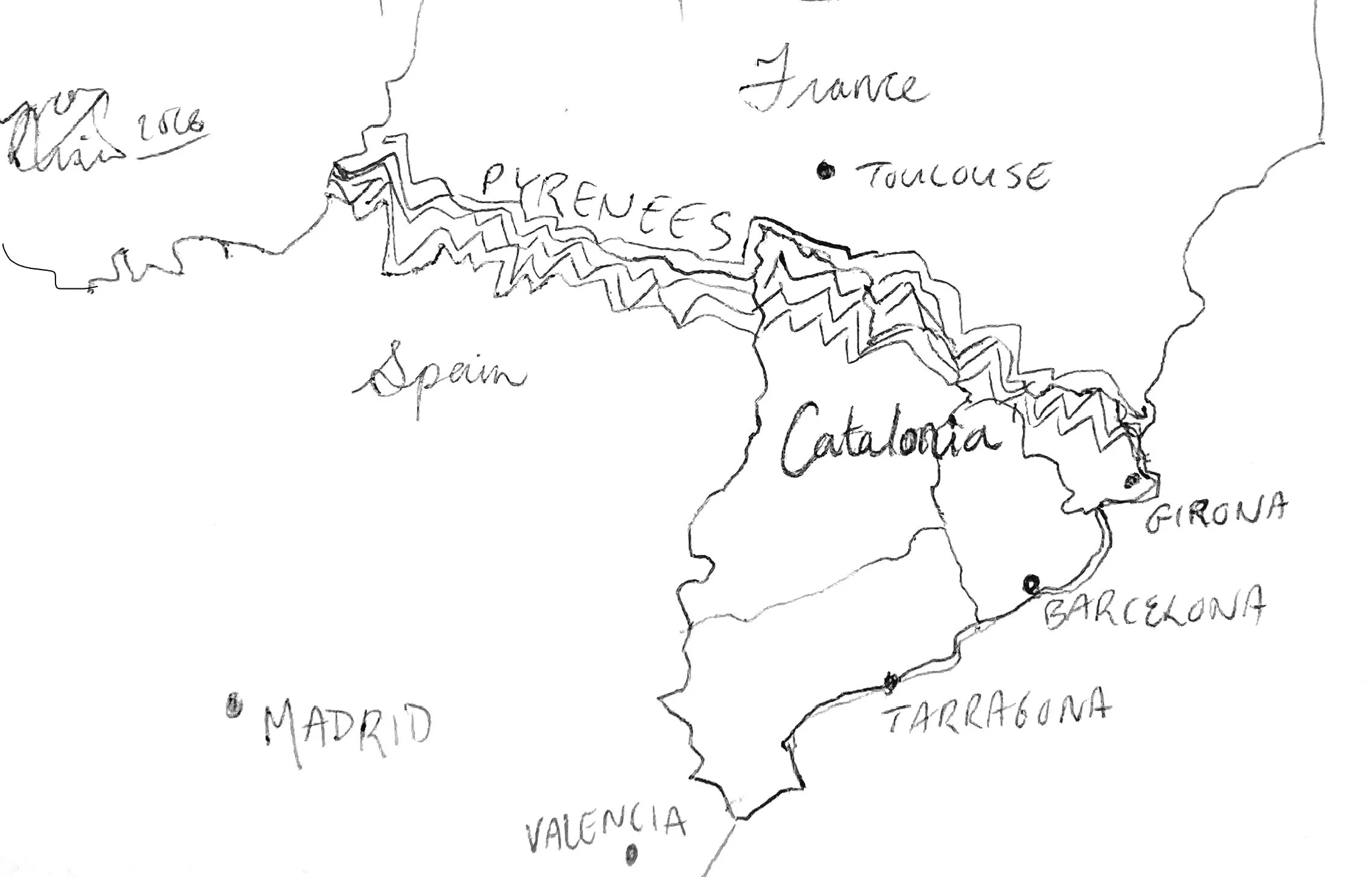
(*map by Incé Husain)
“I was born in the middle of nowhere,” says Mireya Folch-Serra, an emerita professor of geography at Western University whose research focuses on diaspora and exile. She was born on November 14th, 1937, in the midst of the Civil War that led to Franco’s 39-year military dictatorship in Spain. Her mother, the daughter of philosophy professor and rector of the University of Barcelona Dr. Jaume Serra i Hunter, feared giving birth beneath the bombs in embattled Barcelona. She fled to her father-in-law’s cottage in Tarragona. “My grandfather - the father of my father - was a medical doctor. They had a cabin, like a cottage, outside of Barcelona, in the middle of nowhere. So she went to that cabin with family. She had to give birth in that place - no hospital, no anything, just nothing, maybe boiling water.”
Folch-Serra was her mother’s first child. Her younger siblings were born in Toulouse and Mexico City, tracing the family’s displacement.
“My family could not abide by fascism,” says Folch-Serra. “They were all anti-fascists. They were part of the bourgeoisie, but it was an enlightened bourgeoisie. And so they became enemies of Franco, of course. Franco saw them as the enemy because they were liberals, they believed in democracy, all these things that at the time were ‘very bad’...the intellectuals, the professors, were just the total enemies.”
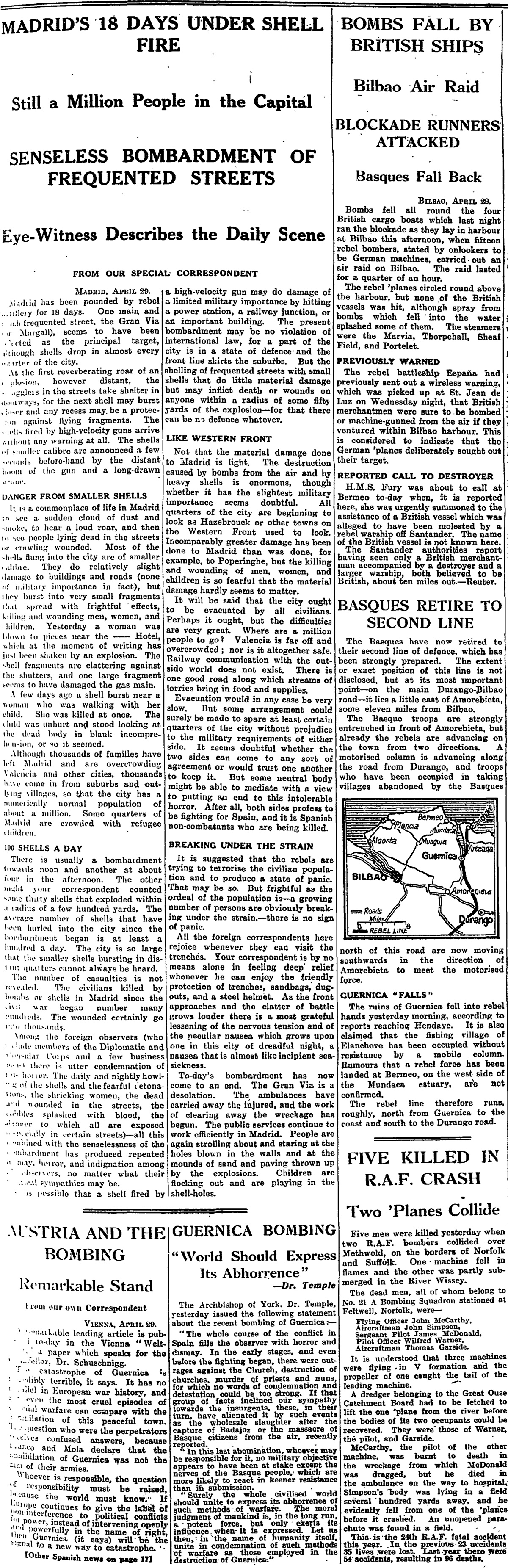
Under Franco - supported by Hitler and Mussolini - cultural heritage sites and civilian centers, including the National Library (Biblioteca Nacional), the Royal Fine Arts Academy (Real Academia de Bellas Artes), and the Museo del Prado, in Madrid and Guernica were bombed. According to archives from The Guardian, Franco said: “Madrid will have to be destroyed district by district, no matter how much I regret it.” An archive from April 30, 1937 reads: It is commonplace of life in Madrid to see a sudden cloud of dust and smoke, to hear a loud roar, and then to see people lying dead in the streets or crawling wounded…A few days ago a shell burst near a woman who was walking with her child. She was killed at once. The child was unhurt and stood looking at the dead body in blank incomprehension, or so it seemed.
Death squads and military courts executed over 100,000 people, including celebrated Spanish poet and playwright Federico García Lorca. Folch-Serra’s father, Emilio Folch Solé, was sentenced to death. He was a doctor who served as Medical Captain in the Republican Army during the civil war of 1936-1939, instigated by Franco’s coup d’état against the democratically elected Second Spanish Republic. In 2001, Folch-Serra unearthed the file containing her father’s sentence from the Tarragona archives. In ‘My Family History of Exile’, a document provided by email, she writes:
Father’s file begins thus: “Emilio Folch ‘domiciliado en Rambla Generalisimo 35, Tarragona (1941).” It is a file full of contradictory statements. It is never mentioned that he is a Captain of the Republican army and a medical doctor and dentist. He is charged with crimes (assassinations of individuals) probably committed by the revolutionaries. There are anonymous accusations that are taken for granted making all sorts of outlandish charges. He is said to be a fanatical “Red,” an atheist, etc. His age and place of birth are given twice, erroneously, without corresponding to each other… Some statements affirm that he’s got property in Montblanc, and others say the contrary, that he’s got nothing. One of the accusations is that he is a member of ERC (Esquerra Republicana de Catalunya) party, and another in the same file, states that he is a founder of ‘Estat Català,’ a different political party. The lies go on and on. One of the most “damaging inculpations” of his accusers is having married Serra Hunter’s daughter (my mother). In another statement he is said to be single. The inconsistencies flow throughout the file. He is sentenced to death.
***
Emilio Folch Solé was not killed by the regime because the family - including Folch-Serra’s grandfathers, grandmothers, aunts, and uncles - fled Barcelona to Toulouse in February 1939, when Franco’s dictatorship began. They were among 500,000 people who crossed the mountainous Pyrenees dividing Spain from France, an exodus known as La Retirada (“the withdrawal” or “the retreat”). Madrid fell to Franco a month later, and Franco’s troops surged through Valencia to Catalonia. Folch-Serra says Barcelona - the capital of Catalonia - was filled with not only Catalans but those from other provinces of Spain because it became “the last place where there was some resistance.” Her family left behind their belongings, jobs, homes, achievements, studies, and academic reputations.
“My family was part of the elite. They had a car, they were given a car or a box or something like that. But the majority of the people went on foot in the winter. And then I heard that they went into a bus with all the professors and people like them. But I’ve seen millions of photographs of people dying because they were walking, and the airplanes of the fascists were killing them from the sky. They were civilians, because the military - like my father - went another way. Even in those moments, there is social hierarchy, which is very sad.”
All the men in Folch-Serra’s family - her father, grandfathers Francisco Folch Calbó and Jaume Serra i Hunter, and uncle Jordi Serra Peraire - were put in concentration camps in France. Her father was put in the Argelès-sur-Mer concentration camp that enclosed over 100,000 refugees from Spain behind barbed wire. In the coming years, that camp grew to imprison other political prisoners, Roma and Jews persecuted during the Holocaust.
“The French allowed the people to get in, but they were not happy with the exodus. The Germans already invaded France - all the refugees that left the fascist regime were now confronted with the Germans.”
Folch-Serra describes her father as “a very, very troubled person who had suffered so much”, marred by PTSD and “shrapnel all over his body”. He remained in the camp for two years, briefly reunited with his family in Toulouse - where Folch-Serra’s brother, Santiago Folch, was born - and then fled to Mexico in October 1941 aboard the Nyassa. He was accompanied by other men who had been sentenced to death under Franco, wary that the Nazis would hand him to the dictatorship. Except for her 18-year old uncle Jordi, all the men in Folch-Serra’s family had been sentenced in absentia; they fled to Mexico, Chile, Uruguay, and other countries in Latin America.
Folch-Serra, her mother, and her brother returned to Barcelona in August 1941. The refugee boats to the Americas were all full, prioritizing those who could be arrested or executed; they hoped to stay in Barcelona until they could find the means to reach Mexico. Folch-Serra’s uncle’s brother-in-law - on the “winner’s side” of the civil war - met them at the border and ushered them in with his influence. Folch-Serra was almost four years old.
In Barcelona, the family lived with Folch-Serra’s great grandfather, Jaume Solé - an elderly “bystander” who hadn’t lost his big house to the civil war - and she happily went to school. Her mother sent her to live on a farm with a family that could feed her eggs and bread.
“There was very little food and no money - and so I remember I was sent to a farm where I could have eggs and bread and things like that, that were not available in the house. For me, it was nothing. I was happy to go to school and happy to go to the farm with this family that would give me food. It was not a big deal. But I imagine it was for the adults who had had a normal life with a house and food and these things.”
In May 1943, five and a half year old Folch-Serra - along with her mother, grandmother, aunt, and brother - boarded the Marquis de Comillas Ocean liner. It took them from Vigo (Galicia) to Havana.
“When we took the boat, it was the second world war, and there were bombs and fighting in the Atlantic,” says Folch-Serra. “Again, the bombs were falling.”
***
They arrived from Havana to Veracruz on a military airplane, reuniting with her father in Mexico City. Here, Folch-Serra remained until 1980. She went to school, learned Spanish (in Barcelona, she spoke only Catalan), made lifelong friends, got married and had two children.
“I remember the place where we arrived - the street was called Calle López. There was a place where all the refugees had gathered, they formed a community. We lived there,” says Folch-Serra. “I had very good friends. My best friend whom I adored - who was also a child with a troubled father, also a doctor - she was an amazing woman who was very important and prominent in Mexico. She was a great journalist and a writer and I still have books from her. She passed away a few years ago. We were very close friends. Her name was Maria Victoria LLamas.”
Most children had attended Spanish schools in Mexico City, but Folch-Serra’s father had sent her to a school run by nuns, insisting that the other schools were “full of communists”. Folch-Serra hated this school, calling herself “a totally secular little creature”. Her parents finally enrolled her in the Escuela Cuauhtemoc from the age of eight to high school. There, she was surrounded by “very revolutionary vanguard teachers” and thrived. She completed high school at another secular school, then went to an art school for two years. But her parents, struggling to make ends meet, could not financially support her university education. Folch-Serra left school and began working in retail.
“They never ever could establish themselves, my parents. They were just barely surviving. They could not pay for my education, or my brother’s or my sister’s. They had four children but they could not support them.”
Folch-Serra’s first visit to Canada was in 1967, when she was hired as a restaurant hostess during six-month world fair EXPO 67 in Montréal. She returned to Mexico, married again and had a daughter, and then emigrated to Canada on March 27, 1980 with her children. She loved Montréal; it filled her with comfort, familiarity, and freedom. Her interests shifted from art to geography. She completed her Master’s degree at McGill University, moved to Kingston to complete a PhD at Queens University, and completed a postdoc at the University of Toronto.
“I really don't know exactly (how I went from art to geography). Art and geography - it has a connection, looking at the space visually. I was always very visual.”
She arrived in London in 1994, when she was offered a job at Western University teaching political geography and geopolitics. She has been in London since. Her course themes focused on the geography of Western Europe and Palestine.
“When I came to London, the department was quite conservative. They were very rightwing - very, very. But it slowly changed and now it is a fantastic place and now I’m retired.”
***
Folch-Serra’s research centers around the concept of a “dialogical landscape”, based on Russian philosopher Mikhail Bakhtin’s “dialogism” framework.
“‘Dialogism’ is a very elaborate concept. But in a very short definition, it means that dialogue always involves an understanding, whereas a monologue is only when you have your say and there is nothing more. A tyranny, an autocracy is monologistic because there is no dialogue. Dialogue is never like that. It is an open concept, and there is never ‘me against you’, it’s always me talking to you and you talking to me,” says Folch-Serra. “The landscape for me is dialogical - you can establish a dialogue with the landscape as a geographer.”
For her doctoral dissertation fieldwork, she returned to the Catalan Pyrenees that she had last seen as a toddler thrust into exile.
“You always go back to the site of the crime, right?” says Folch-Serra of her 1988 research visit. “I talk about collective memory, historical memory, and all the derivatives of memory, because memory can be repressed of course - and indeed, in many circumstances it is - and it also can be an instrument of reparation.”
In Linking repression and exile: a geography of the Spanish Republic Diaspora 1939-1975 (2006), she argues that most research analyzes exile and repression separately. She advocates instead for unearthing the ties between them, pointing out that people refused to “talk and remember” even after Franco died in 1975. She writes:
It is important not only to quantify the terror but also to qualify it in the sense of assessing its long term social and political consequences. Forced self-censorship, state censorship, coercion, the segregation of the defeated, discrimination based on gender and culture, lack of religious freedom and, for sure, the prohibition to choose political representatives, are part and parcel of the repression.
“In reality, most people who have lived those exiles don't like to talk about it. My father never talked about the war. My mom didn’t even want to remember anything. It is like the past didn’t exist,” says Folch-Serra. “They don’t have an idea of what’s happening. They don’t have a narrative. They only have some experiences, and they don’t want to talk about painful ones. I heard of other descendants of exiles and refugees - the families don’t want to talk. They are not a book, they are people.”
Sometimes, snippets of her family’s past would emerge in conversations. She remembers her mother sharing that they had a beloved family dog named Tom who they had to leave behind when they fled.
“That was a tragedy because my mom was a young woman, and leaving the dog and losing the dog was a big deal. So I remember the story of Tom the dog. But just things like that.”
Some of Folch-Serra’s family died in exile without seeing their country again. In “My Family’s Story of Exile”, she writes: My four grandparents could never come back, and died in Mexico and Cuba longing for their country. My father, condemned to death for crimes he did not commit, also died in exile.
Others made it back to Spain. Folch-Serra’s sister, Silvia, moved to Madrid in 1981. Folch-Serra returned to Spain in 1983; forty years had passed since her days at the Barcelona farm.
“The first time I went to Spain, it was weird because I didn’t go to Catalonia. I went to Madrid with my sisters, and we travelled around, and it was weird because I didn't recognize it, I didn't recognize myself as a Spaniard.”
She obtained her first Spanish passport in 1993, and her identity card in 1996. She notes that it took about two years for her to obtain Spanish citizenship through the Spanish Consulate in Toronto - a longer process than required for “regular immigrants” from other countries to become Spanish citizens.
She returned to Catalonia in 1986, and lived there from 2000-2001 for a sabbatical based at the University of Girona. In 1991, she met three of her cousins and their families for the first time, staying at her cousin Menchu Folch Camps’ family home in Bellcaire d’Empordá, Girona. She gathered there with a group of cousins again in 1996. In 1998, Menchu organized the Primera trovada dels Folch (“the first encounter of the Folch family”), uniting many relatives in the diaspora for a three-day party.
“Language is the link between [the] tradition and [the] history,” says Folch-Serra. “I can speak Catalan and I can read perfectly, but I cannot write it. Which is a shame, because when I exchange information and things with my colleagues in Catalonia, I have to write in Spanish, and they write in Catalan. I never learned how to write and I always had that shame…I feel emotionally attached to Catalonia and the language and my history. All my history is in Catalan.”
Under Franco’s rule, speaking Catalan was banned from school systems and public life. Police and other authorities would declare: Hable el idioma del imperio (“use the language of the empire”). Catalan lecturer Irene Boada of Queen’s University writes that the Catalan language “lost prestige” compared to Spanish. Upper-class Catalans began to speak more Spanish and migrants from the south of Spain - who arrived in the millions in the 1950s - were disinterested or prejudiced against learning Catalan. Many didn’t know Catalan was even a language.
In the short story “Catalans in the World” by celebrated Catalan writer and journalist Pere Calders, a Catalan traveller bonds with a parrot uttering Catalan phrases: Many were the things which made us different but there was a language which made us one.
***
Folch-Serra used to describe herself as “very nationalistic” as a Catalan. But now she is sensitive to the ways Catalonia has become home to immigrants from across the world, and no longer resonates with the idea of Catalonia becoming independent from Spain on the basis of distinct linguistic and cultural histories.
“For a while, I was very nationalistic. I couldn't be that nationalist because I didn't live there, but I felt very nationalistic… [Catalans] defend their language because the language is always attacked by [the] others. They have to defend the language, they have to defend their way of life which is different, and they are always, always fighting. Especially during the war, they were the target of Franco, Franco hated the Catalans, and the Catalans in general were more anti-fascist than other people,” says Folch-Serra. “But at this moment in time, Catalonia has a lot of immigrants…You should see the amount of immigrants in the tiniest villages. Small kids from Africa speaking better Catalan than I do. For these kids who are Black Catalans, whose parents and grandparents came from Africa and are living in the Pyrenees, in Barcelona - they don't have that idea of [the] oppression…I love it… I would ask them ‘what do you think of independence’? The demographics are changing, and with the changing of the demographics, the sense of nationalism also has a different meaning. And I changed too. I would be a non-nationalist, a new observer.”
In 2013, Folch-Serra painted “Shadow”, an acrylic piece depicting a sculpture of a kneeling woman in a garden that sprawls over the ruins of a stone archway. Within the archway is the woman’s “shadow”, her body overrun with branches and leaves. The painting was inspired by a photograph Folch-Serra took when she visited the Catalan Pyrenees in the 1980s, its landscapes filled with Romanesque ruins and villages nestled in valleys and mountains. She writes:
Going back to the Pyrenees in the 1980s, I felt like a tree growing new branches and leaves after having been deracinated and taken away by circumstances beyond my grasp…The woman in this painting signifies the longing for a lost and idealized past represented by her shadow inside the ruin. Shadows, like memories of the past, are dreamlike and ungraspable but can be represented in an artwork.
She often paints animals and nature. She shares that she has painted scenes of birds fighting drones, “the most horrible instruments of killing and war”. During the Iraq war, she joined London and Toronto artists in drawing in the galleries of Islamic Art and Mesopotamian Art at Toronto’s Royal Ontario Museum, an act of protest called Drawn In organized by London-based artists Ron Benner and Jamelie Hassan, and Toronto-based artist Serge Arcaro.
For an art project on Palestine, organized by London artist collective Embassy Cultural House, she contributed a photograph of the apartheid wall painted with a mural of the Palestine flag and Catalan independence flag - known as the estelada - flanking Handala and surrounded by silhouetted protesters. Beneath the flags are words for freedom in Catalan and Arabic - llibertat beneath the Palestine flag, and huriya (حرية) beneath the estelada. The mural is signed “Gramenet”, the name of an ancient village in the Catalan Pyrenees. Folch-Serra had seen the photo in a Catalan publication.
“It feels to me like I've always heard about Palestine, that's the feeling…As a student doing my Masters, I was living in that moment of [South African] apartheid, I knew people from South Africa… From that place, when I heard about Palestine, I also saw from the very beginning the parallels between South Africa and Palestine, parallels of white settlers and colonialism,” says Folch-Serra. In June 2025, she published an open letter addressed to Western University’s president Alan Shepard declining a celebratory meal for retired professors due to Western University’s support for the Israeli occupation. She wrote:
It is impossible for me to enjoy a celebratory meal with Western colleagues when our Palestinian colleagues in Gaza are enduring a brutal famine deliberately imposed by an occupying power which is actively supported by your Administration. How can we gather on our beautiful, peaceful campus while ignoring the fact that Israeli occupation forces have deliberately destroyed all of the Universities in Gaza?
Today, she goes to as many Palestine protests as she can.
“I think, unconsciously, I am so close to what’s going on in Gaza. Because I see they are targeting civilians and I survived as a civilian who was meant to be killed,” says Folch-Serra. “Sometimes I cannot sleep because I see my personal history repeated. It's horrible. When you become a survivor of a war and then an exile, it follows you, it’s something you cannot simply erase. So all these people, all these children in Gaza, in the West Bank, it's going to be generational. You can survive, and you can have a life, and you can produce something, but there is always the sediment of the past in your life.” ♦
Mireya Folch-Serra reviewed this article prior to publication to ensure accurate and respectful coverage.
Special thanks to David Heap for helping arrange, guide, and translate some parts of the interview.